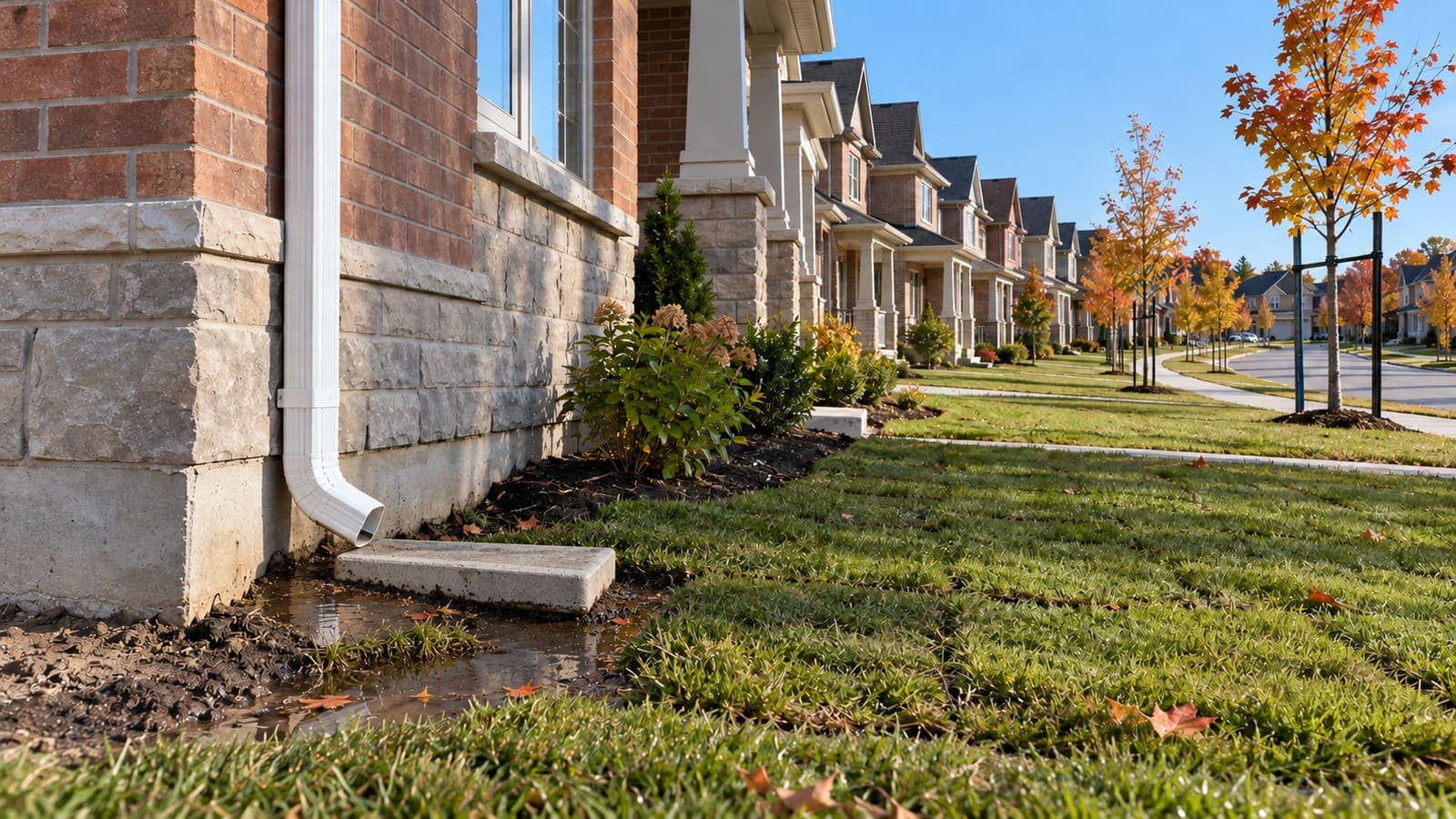
Tarion's warranty covers eavestroughs, downspouts and lot grading on a new Ontario home for one year. The builder must repair troughs that leak at the joints, overflow from poor slope or fail to drain to grade, and grading that lets water pool against the house. Keeping troughs and downspouts clear of debris is the owner's job.
What does Tarion cover on eavestroughs and downspouts?
Tarion's Construction Performance Guidelines set out how it settles warranty disputes between owners and builders. Four articles cover eavestroughs, all under the one-year warranty on work and materials.
| Guideline | What the builder owes you | Not a defect, or your job |
|---|---|---|
| 5.20: leaks | No leaks at the joints | Rain hitting the outside face and dripping off |
| 5.21: overflow in normal rain | Troughs sloped to the downspouts; overflow from poor slope is covered | Some overflow where roof flows converge; debris is the owner's job |
| 5.22: not performing | Water drained to grade, with extensions that prevent erosion where spouts aren't tied to a sewer | Clearing debris, which Tarion calls normal home maintenance |
| 5.23: won't drain completely | Troughs that generally slope to their drains | A minimal amount of standing water |
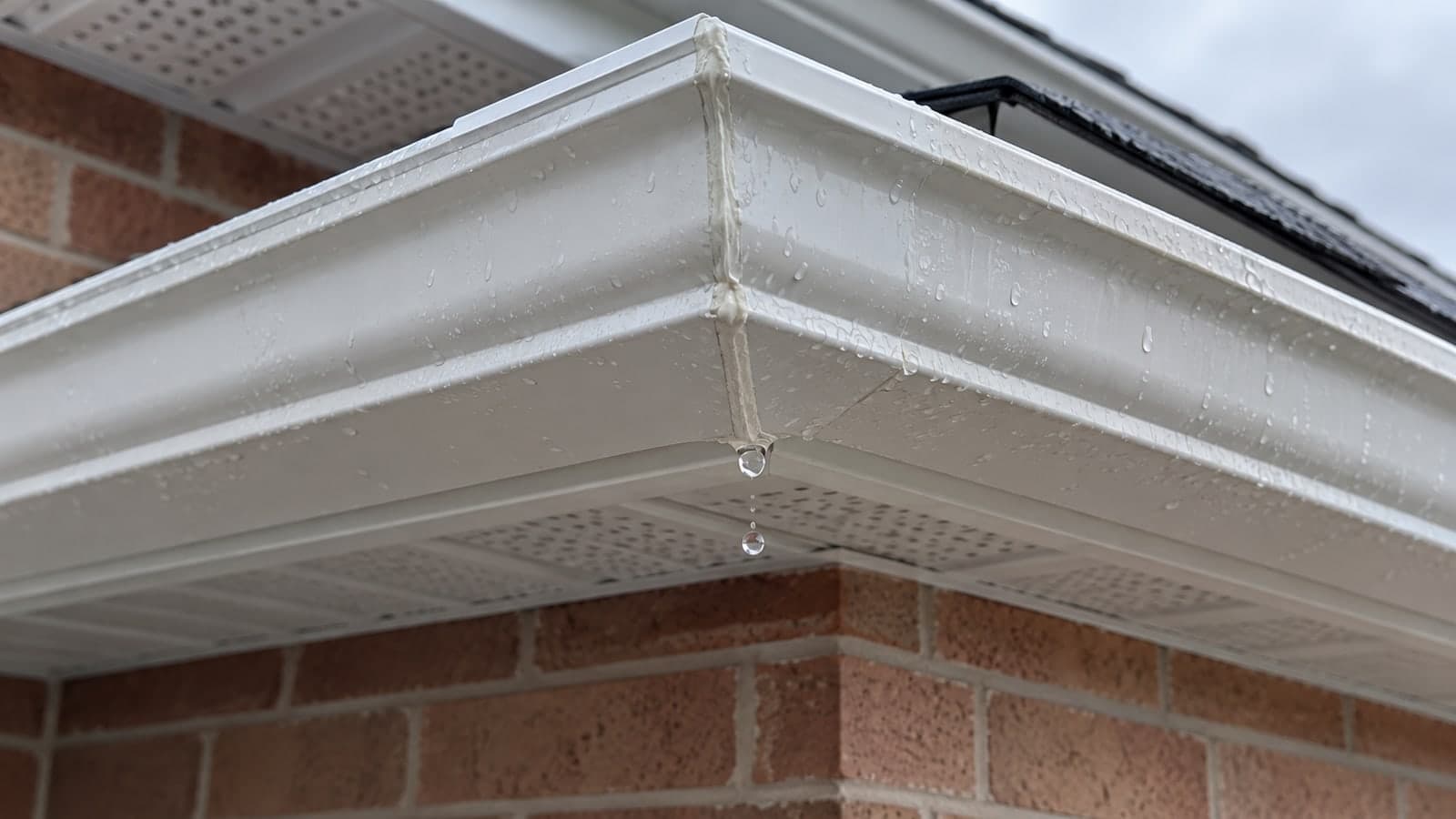
Knowing which one you have makes the report stronger. A drip from the seam itself is a 5.20 leak, and how seams fail shows where to look. Water spilling over the front of a clean trough, or lying along a whole run after the rain, usually points to slope.
Is lot grading covered, and for how long?
Yes, for one year. Guideline 14.12 says the lot must be graded so water doesn't generally collect next to the house, and backfill against the foundation must still drain away after it settles. Where no grade is specified, a 2% slope is acceptable (2 centimetres of drop per metre, about a quarter inch per foot), and sodded or gravelled areas may slope as little as 1%.
The grading has to follow the municipally approved plan, and Tarion notes that ponding can appear early because grading isn't always finished at move-in. General land settling around the house or along utility lines, landscaping changes you make and poor maintenance are excluded. After year one, the finished grade is yours to maintain.
What about a wet basement in a new home?
Basement leaks fall under the two-year warranty, which protects against water penetration through the basement or foundation walls. Under guideline 1.13, only actual trickling water counts, not dampness or condensation.
The exclusions are where gutters come in: leakage from improper maintenance, or from grade changes the homeowner made, is not covered. A leaf-packed downspout emptying at one corner invites exactly that argument, so keep spouts flowing and extensions attached for the full two years. If water gets in, the guideline says to act right away and report losses to your home insurer, then trace the source.
When should you file, and on which form?
Tell your builder in writing first; Tarion expects builders to get the first chance to fix things. Then put each item on a Tarion form in MyHome. For homes with possession on or after May 1, 2024, the first-year forms run on a fixed clock:
| Form | Add items from | Submitted |
|---|---|---|
| Initial | Day 1 after possession | Automatically on day 41 |
| Mid-Year | Day 42 | Automatically on day 183 |
| Year-End | Day 183 | Automatically on day 365; only one is accepted |
| Second-Year | Any time in year two | When you send it; as many as you need |
Each submission gives the builder a 120-day repair period under Tarion's service standard. If the builder doesn't resolve an item, you can ask Tarion for a conciliation inspection, which for Year-End items means by day 516. A 10-day grace period after day 365 needs written proof that you reported the items to the builder in year one.
What is your job as the owner in year one?
Some of it starts the day you get the keys. The overflow guideline says the homeowner shall keep eavestroughs and downspouts free from debris, and Tarion's ice buildup article recommends cleaning them in both fall and spring.
- Get the troughs cleared and the spouts flushed after the fall leaf drop and again in spring. On a new street, the first loads often include granules from the new roof and construction leftovers.
- Keep each extension and splash pad in place and aimed away from the house, as where downspouts should drain shows.
- Leave the grade alone: no garden beds piled against the foundation, no patio sloping back toward the wall.
- Keep window wells clear of leaves and snow, which Tarion's window well article calls regular maintenance.
- Keep a dated file: your pre-delivery inspection form, messages to the builder, and photos after storms and cleanings.
What does Tarion not cover on the roofline?
Tarion's general exclusions include normal wear and tear, damage from improper maintenance, damage by a third party or by homeowner actions, and acts of God. A branch through a downspout or a run torn off in a windstorm is usually a home insurance question instead.
Ice is the grey zone. Guideline 5.6 covers ice buildup on the roof only when it stems from a Building Code violation or a builder defect, and leaks from ice dams are covered under 5.4 only if a demonstrated builder defect caused the dam. How ice dams start explains why a clear trough in November matters.
The guidelines do change. Tarion consulted in early 2026 on revised water articles, and the published version still carried a June 6, 2024 date at the time of writing, so check the current wording before you file.
What does this look like in Pickering?
Pickering has both ends of the warranty clock. Up north, Seaton is a new community planned for about 61,000 residents. Tarion judges grading against the approved plan, and the City's lot grading criteria call for at least 2% drainage away from every building, a rear apron sloping away for at least 5 metres, and a stone-covered swale between houses 1.2 metres apart or less.
The same criteria connect downspouts on lots with 12 metres of frontage or less to the storm sewer, unless the City directs otherwise. If your spouts vanish into a pipe in the ground, a clog shows up as overflow at the top. Your subdivision's approved plan is what counts, so check with the City for your lot.
Farther south, the 1970s and 80s two-storeys of Liverpool and Amberlea and the Bay Ridges bungalows are long past any builder warranty, with original spikes and seams at retirement age. Rougemount and Rosebank take oak and maple from the Rouge and Petticoat Creek corridors from late October.
While your home is under warranty, report defects to the builder before anyone touches them, because homeowner alterations are excluded. A cleaning alters nothing: the crew clears the troughs, flushes each downspout and emails before and after photos for your file. A Pickering gutter cleaning is $349 for a two-storey townhouse and $399 for a two-storey detached home, before HST in 2026. After the warranty, gutter repair in Pickering fixes loose hangers, leaking joints and sagging runs from $89, priced on site and approved first.
Sources
- Tarion: Construction Performance Guidelines for freehold homes and condominium units (PDF)
- Tarion: Warranty coverage after you close
- Tarion: Claim forms and timelines
- City of Pickering: Engineering design criteria, lot grading (PDF)
Frequently asked questions
Does Tarion cover gutters that overflow?
Only when the build is the cause. Tarion's guideline 5.21 covers overflow from inadequate slope, or from not meeting municipal requirements, in the first year. Some overflow where roof flows converge is accepted, and clearing debris is the owner's job.
Who is responsible for cleaning the gutters on a new build?
The homeowner, from the day you take possession. Tarion's guidelines say the owner shall keep eavestroughs and downspouts free from debris, and recommend cleaning them in both fall and spring.
Is standing water in a new eavestrough a warranty defect?
Usually not. Tarion's guideline 5.23 calls some minimal standing water normal. Water lying along a whole run after the rain stops suggests the trough doesn't slope to its outlet, which is worth reporting in the first year.
When is the deadline to report grading problems to Tarion?
Grading is a one-year item, so it belongs on a first-year form. The Year-End Form goes in automatically on day 365 after possession, and the 10-day grace period after that needs written proof you told your builder.
Keep reading
- Buying a home? A 10-minute gutter and roofline check
- How much slope should gutters have? Checking the pitch
- Water in the basement after rain: how to find the source
- Gutter repair: what is included and how it works
- Eavestrough & gutter repair in Pickering: local prices and booking
- Everything we do in Pickering: neighbourhoods, trees and services