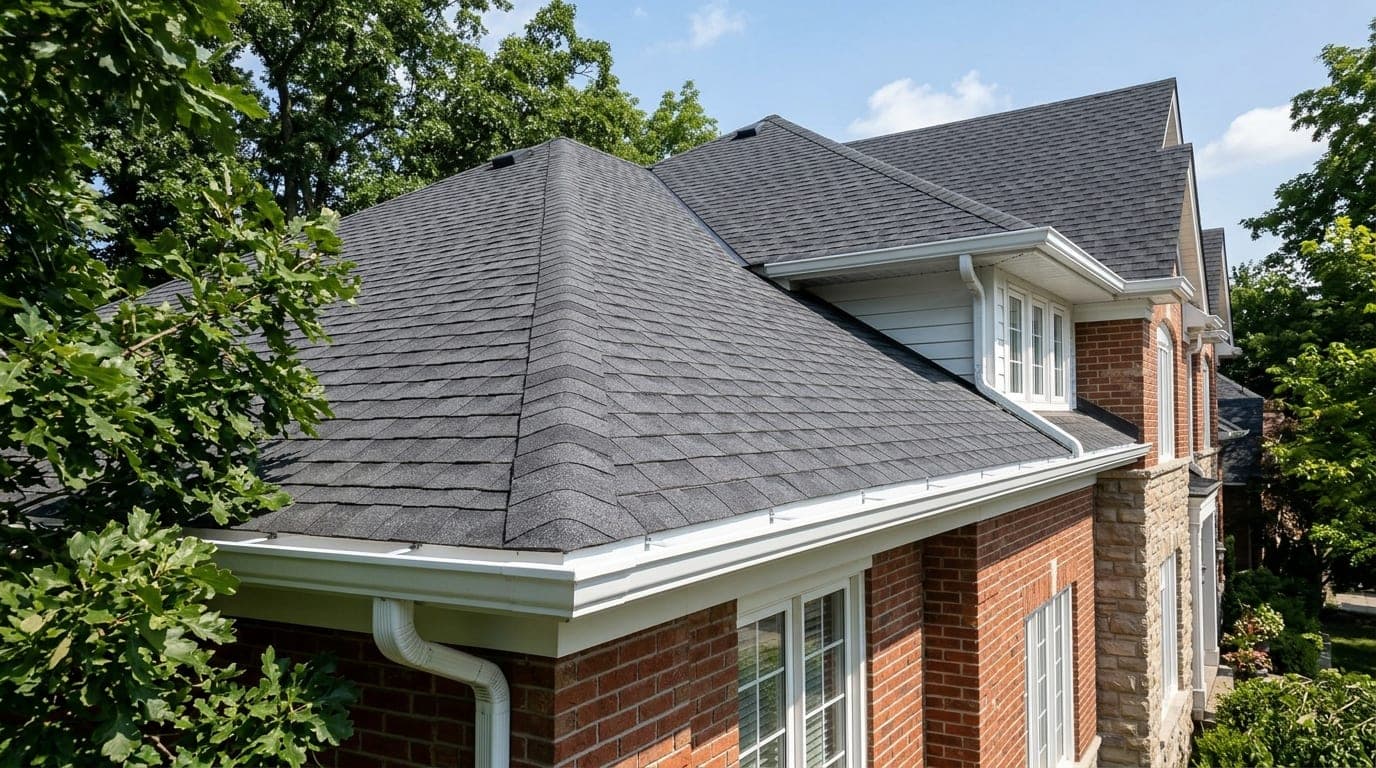
Gutters should slope toward the downspout by roughly 1 to 2 millimetres per metre, the equivalent of 1/8 to 1/4 inch every 10 feet. Long runs over about 12 metres usually slope both ways from the middle to two downspouts. Too little slope pools water; too much looks crooked from the street.
Why does gutter slope matter?
A gutter is a very shallow channel carrying a lot of water. On a flat run, water only moves when enough of it piles up to push the rest along, so every rain leaves water behind, with the grit and leaf fragments it carries. That residue builds into the sludge that eventually clogs the outlet. A steady fall keeps the water, and what is in it, moving to the downspout.
Too much slope has its own problems. The low end of a steep run sits well below the roof edge, so water can overshoot it in heavy rain, and a gutter that visibly tilts looks wrong on the house. The goal is the smallest fall that drains completely. The gutter pitch glossary entry has the one-line version.
What are the numbers for your run?
| Length of run to the outlet | Total drop at 1 mm per metre | Total drop at 2 mm per metre |
|---|---|---|
| 3 m (10 ft) | 3 mm (about 1/8 in) | 6 mm (about 1/4 in) |
| 6 m (20 ft) | 6 mm (about 1/4 in) | 12 mm (about 1/2 in) |
| 9 m (30 ft) | 9 mm (about 3/8 in) | 18 mm (about 3/4 in) |
| 12 m (40 ft) | 12 mm (about 1/2 in) | 24 mm (about 1 in) |
| Over 12 m | Split: slope each half to its own downspout | Split: slope each half to its own downspout |
Those drops are small, which is the point. On a 12-metre run, the whole fall is about the thickness of your thumb. Split runs, highest in the middle and falling to a downspout at each end, keep long eaves from sitting noticeably lower at one corner.
How do you check your gutter slope?
There are three ways, from easiest to most precise. All of them start with a clean gutter, because debris hides the problem.
- 1The after-rain look: a day after a good rain, check the trough from an upstairs window or a ladder. Any stretch holding more than about a centimetre of water is a low spot.
- 2The hose test: run a garden hose at the far end of the run and watch. Water should travel steadily to the outlet and leave nothing behind when you turn it off.
- 3The level test: lay a short spirit level on the bottom of the gutter every metre or so. The bubble should sit consistently just off-centre toward the high end; a bubble that flips direction marks a dip.
Why do gutters lose their slope?
- Freeze-thaw cycles work old spike-and-ferrule hangers out of the fascia a little every winter.
- Weight: wet leaves, packed debris and ice pull down hardest mid-span, between hangers.
- Ladders leaned against the gutter bend the lip and kink the run.
- Soft or rotted fascia stops holding fasteners, so the gutter drops with it.
- Roofing work: new shingles or drip edge sometimes means the gutter is re-hung in a hurry.
How is a flattened gutter fixed?
Re-pitching is a matter of re-hanging. The installer snaps a chalk line on the fascia from the high end to the outlet at the right fall, then loosens the hangers and re-fastens the gutter to that line, replacing old spikes with screwed hidden hangers and adding hangers where the spacing is wide. In snow country, many installers space them about every 60 centimetres. If the fascia is soft, it has to be repaired first, because no hanger holds in rotten wood. Sagging gutters goes deeper on that.
What about Oakville's long rooflines?
Oakville's stately two- and three-storey homes near the lake, and the family two-storeys through Glen Abbey and River Oaks, tend to have long, uninterrupted eaves and steep roofs. That combination is where slope matters most: a long run with a single outlet has to be pitched carefully or split, and a steep roof delivers water fast enough to show every flaw. Towering oaks and maples in Old Oakville add the debris weight that drags runs out of line.
Short sagging runs are a routine fix. Gutter repair in Oakville covers re-fastening loose hangers and re-levelling short runs, from $89, priced on site and approved by you before work starts. Larger re-hangs or fascia repairs get an honest referral to the right trade.
Frequently asked questions
Can gutters be completely level?
They can drain when level, but poorly: water only moves once enough collects to push it along, so a level gutter always holds some water and the grit in it. A small fall of about 1 to 2 millimetres per metre drains completely.
Should gutters slope toward or away from the downspout?
Toward it. Each run should fall steadily to its outlet. On runs longer than about 12 metres, the gutter is usually highest in the middle and falls both ways to a downspout at each end.
How do I know if my gutter slope is wrong?
Water standing more than about a centimetre deep a day after rain, overflow in the middle of a run instead of at the corners, or a hose test that leaves water behind all point to a slope problem.
How far apart should gutter hangers be?
Closer than many older installs. In areas with heavy snow and ice, many installers space hidden hangers about every 60 centimetres (24 inches), and closer at corners and under valleys where loads are highest.
Keep reading
- Why your gutters overflow even when they're clean
- Sagging gutters pulling away from the house: why and fixes
- Standing water in your gutters: causes and mosquito risk
- Gutter repair: what is included and how it works
- Eavestrough & gutter repair in Oakville: local prices and booking
- Everything we do in Oakville: neighbourhoods, trees and services