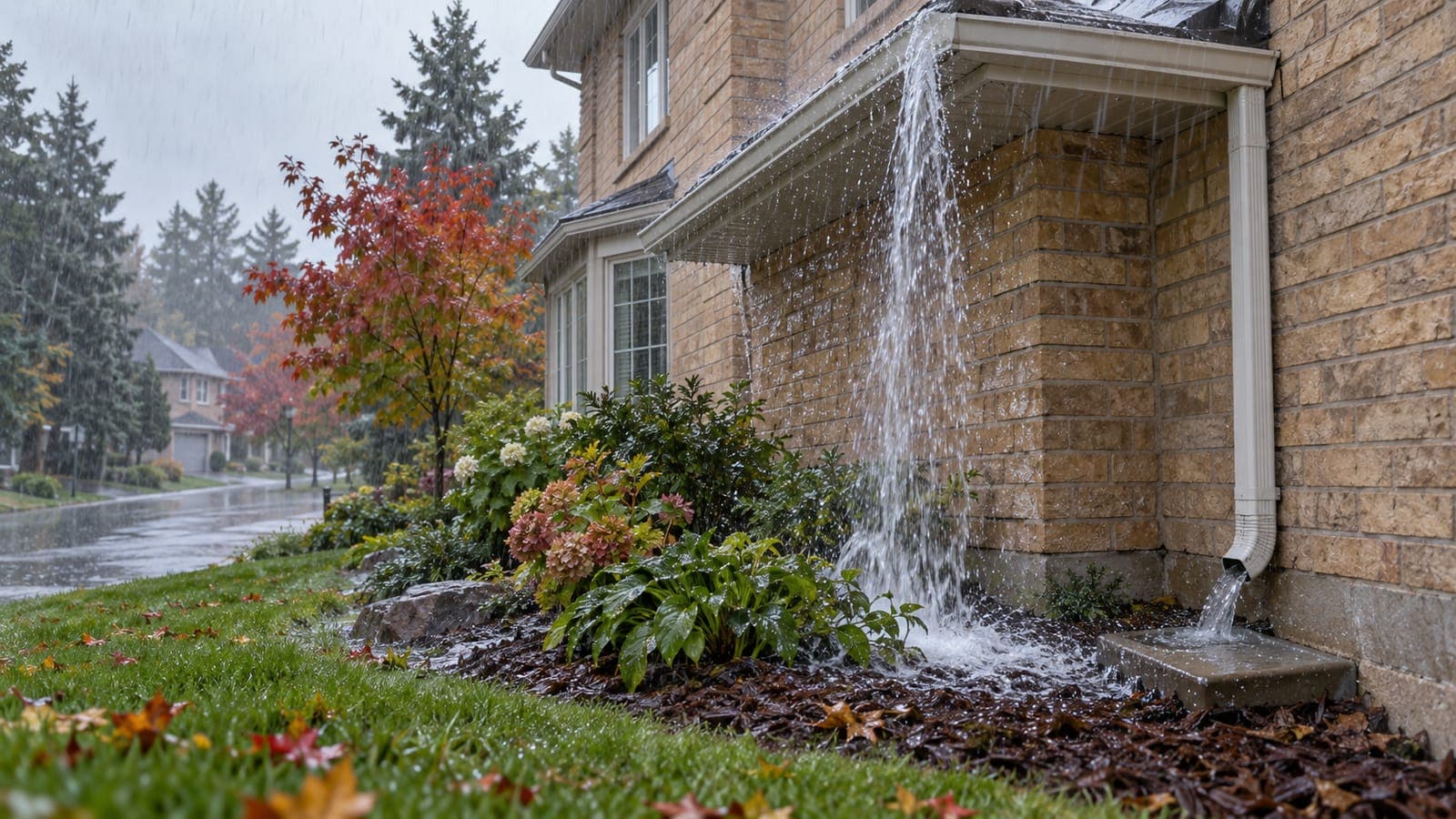
To find where basement water comes from after rain, work from the roof down. Watch the eavestroughs in the next downpour for overflow, make sure every downspout empties about 2 metres from the wall, then check grading, window wells and wall cracks. Water rising through the floor drain usually means a sewer backup: call your city and a plumber.
Where is the water coming in?
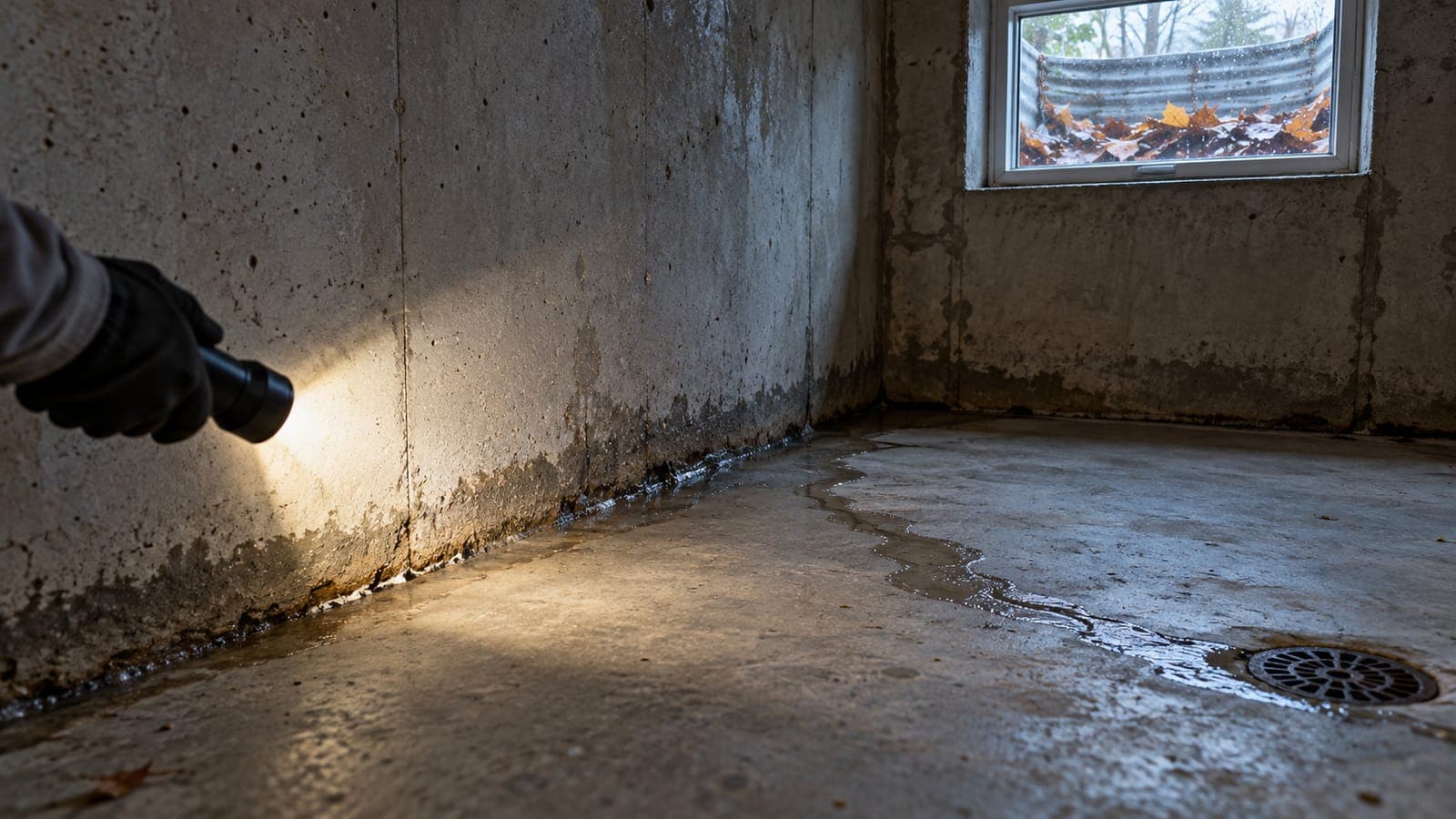
Rain gets in through the walls or up through the drains. The City of Toronto's basement flooding page lists overflowing eavestroughs, plugged downspouts, poor grading, cracks and failed foundation drains as causes of the first; the second is a sewer backup. Note where the water shows up.
| Where you see water | Likely cause | Who fixes it |
|---|---|---|
| Along the base of one wall | Roof water or grading soaking the soil | A gutter crew; a landscaper for grading |
| Running down from a crack | Water pushing through the wall | A waterproofing contractor |
| At a basement window | A flooded window well or failed seal | You, then a waterproofing contractor |
| Rising out of the floor drain | A sewer backup | Your city, then a licensed plumber |
| Across the floor after days of rain | Groundwater, foundation drains or sump pump | A plumber or waterproofing contractor |
| Damp walls in muggy weather | Condensation | You, with a dehumidifier |
| Near pipes or appliances, any weather | A plumbing leak | A licensed plumber |
Step 1: Is your roof water landing against the wall?
Start at the roofline, the cheapest cause to rule out: water from a clogged gutter lands right beside the wall. In the next downpour, walk around the house in a raincoat. Stay off ladders: you can see it all from the ground.
- Water sheeting over the gutter's front edge or pouring off an inside corner
- A silent or dribbling downspout under an overflowing gutter, the sign of a clog
- A downspout ending at the wall, or a splash pad tipped back toward it
- Puddles against the foundation a day later, a red flag in Mississauga's Rain-Ready Home Guide
Then line it up: an overflowing corner, an emptying downspout or a puddle directly outside the wet patch is your most likely source.
Clear the gutters and downspouts, then carry the water away. Peel Region asks for extensions of at least 2 metres (6 ft.) onto ground that slopes away, and where downspouts should drain covers the setup. If clean gutters still spill, see why gutters overflow when clean.
Step 2: Does the ground slope toward the house?
Mississauga's guide says the ground should ideally fall 2 to 3% over the first 2 metres (6 ft.) from the wall: roughly 4 to 6 cm (1.5 to 2.5 in.).
To check, rest a straight board about 2 metres long on the ground at the wall, set a level on it and lift the far end until the bubble centres. The gap underneath is your drop. If the wall end needs lifting instead, the ground slopes toward the house.
Settled backfill, sunken patios and garden beds heaped against the brick are the usual culprits. Filling a small low spot with clean clay soil, as the guide suggests, is a weekend job. Regrading a yard is landscaper work, and must not push water onto a neighbour's lot.
Step 3: Why does water come through the basement window when it rains?
Usually because the window well is filling. Mississauga's guide explains that most wells drain through a pipe at the bottom, often under the gravel, into the weeping tiles. Once leaves block it, water fills the well and presses on the window until it leaks.
- Clear out leaves and silt, then find and clear the drain.
- Seal the rim to the wall; the guide wants it 76 to 100 mm (3 to 4 in.) above the soil.
- Look up: a gutter corner spilling into the well undoes the rest.
- Fit a clear cover that opens from inside: a bedroom window may be a fire exit.
If the well stays dry and the window still leaks, the seal has failed; if the well keeps filling, its drain is blocked. Either way, call a waterproofing contractor.
Step 4: What if water comes through a crack?
A wet line down from a crack after each storm means water is pushing through the wall. Cracks only leak when the soil outside is wet, so do steps 1 to 3 first.
If it still leaks, a basement waterproofing contractor can seal it from inside or outside. A wide, horizontal or growing crack, or a bowing wall, needs a structural engineer before any patching.
Step 5: Is water coming up through the floor drain?
Water rising out of the floor drain, often grey and smelly, usually means a sewer backup. Toronto's page traces it to blocked, broken or overwhelmed sewer lines, from heavy rain, tree roots or things flushed that should not be. Clean gutters will not stop it.
Call your municipality first (311 in Toronto), then a licensed plumber and your insurer, and photograph everything; sewer backup coverage is often an add-on. A backwater valve is the usual fix, and Toronto's subsidy and other GTA programs help pay for one.
The roofline link is indirect: a downspout piped into the ground may feed the same sewer, and Peel Region warns that rainwater in the sanitary sewer can overload it in heavy rain. Moving that water onto the lawn helps.
Step 6: Could it be condensation or a plumbing leak?
Damp in muggy weather, or after days without rain, points indoors. Natural Resources Canada suggests taping plastic about 1 metre (40 in.) square to the wall for a day or two. Moisture on top means humid indoor air, a job for a dehumidifier; moisture underneath means water from the ground.
A puddle in any weather, by the water heater, washer or a pipe, is a plumbing leak for a licensed plumber. Richmond Hill's leak guide shows how to check for one at the water meter.
What does this look like in Richmond Hill?
Richmond Hill climbs the Oak Ridges Moraine. On a sloping lot the uphill wall gets roof water plus the yard's runoff, and a downspout aimed uphill sends water straight back; the extension may need to run along the house to lower ground.
Under the oak and white pine of Oak Ridges and Jefferson, judge the gutters in the rain: needle felt can leave a trough looking clear while water rides over its edge, as the pine needle guide explains.
Richmond Hill got 69.4 mm on September 2, by Environment Canada's preliminary count (CP24). If your basement took water, start with where it came in; the post-storm checklist covers the gutters.
For a floor drain backup, the City asks you to call right away at 905-771-8800; it sends a drain contractor, and you pay for the call only if the cause is on the private side. Its backwater valve subsidy lists up to $1,500, subject to funding, and requires downspouts disconnected from the City sewer.
A gutter cleaning in Richmond Hill is a simple way to rule the roofline in or out: $369 for a two-storey semi or $399 for a two-storey detached, before HST in 2026. Every downspout is flushed, flow-tested and checked against the slope, and the before and after photos help brief any other trade. The crew does not regrade, seal cracks or work on sewers, and will tell you plainly when you need one that does.
Frequently asked questions
Who do I call for water in my basement after rain?
It depends where it comes in: a gutter crew for overflowing gutters and short downspouts, a landscaper for bad grading, a waterproofing contractor for a leaking crack, and your city and a licensed plumber for water rising through the floor drain.
Why does my basement only leak in heavy rain?
Heavy rain tests every weak point at once: a partly clogged gutter overflows, the soil against the wall saturates and pushes water through joints and cracks, and sewers can back up. Check the roofline above the wet wall first.
Is water coming up through the floor drain a gutter problem?
Not directly. It is usually a sewer backup, which needs your municipality and a licensed plumber. Gutters only play a part when downspouts feed underground pipes tied into the sewer, adding rainwater to an overloaded system.
Keep reading
- What clogged gutters actually do to your foundation
- Where should your downspouts actually drain?
- Gutter damage after a storm: what to check in the GTA
- Gutter & eavestrough cleaning: what is included and how it works
- Gutter & eavestrough cleaning in Richmond Hill: local prices and booking
- Everything we do in Richmond Hill: neighbourhoods, trees and services