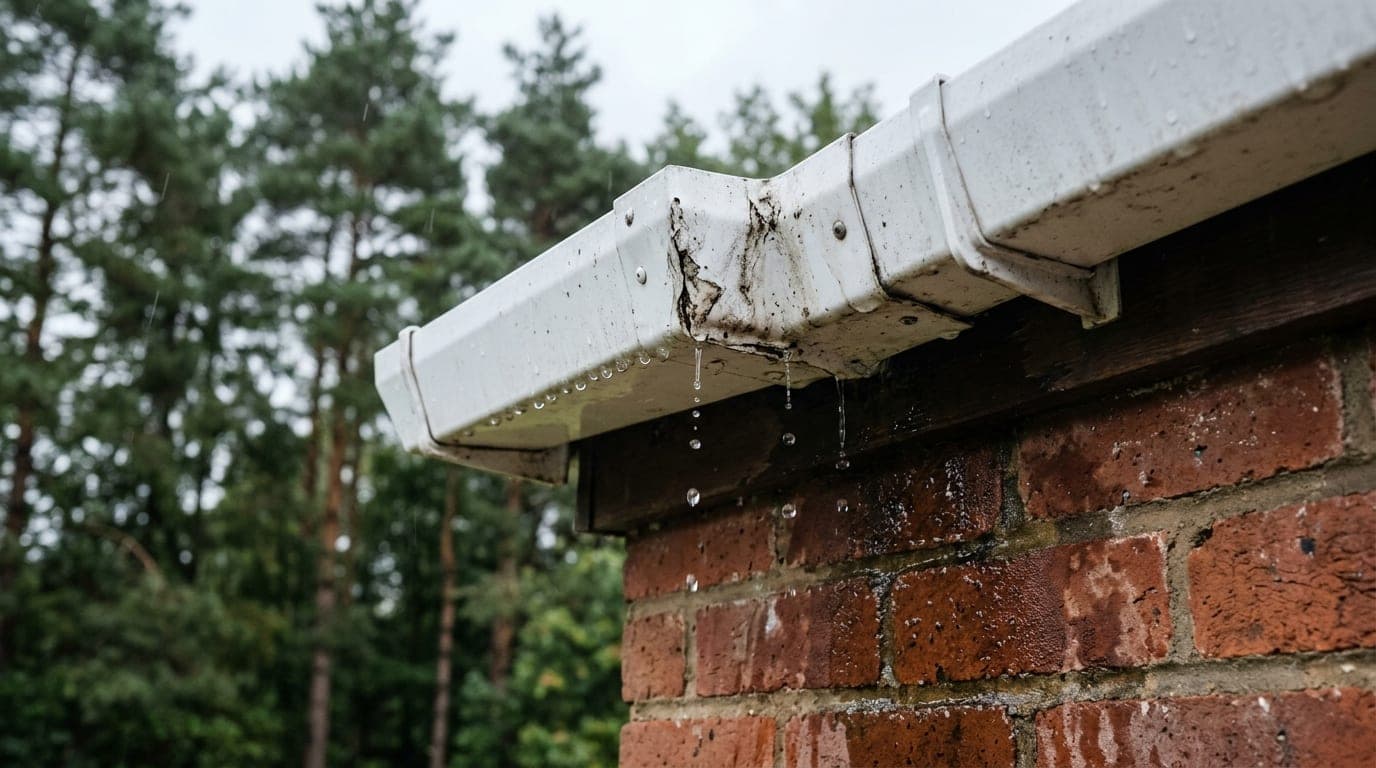
Gutters leak at seams and corners because the sealant in those joints dries, cracks and lets go after years of sun and freeze-thaw cycles, and because ice and debris weight work the joints loose. Most leaks are a failed seal, a loose end cap or a popped rivet, fixable by cleaning the joint and resealing it.
Where do gutters usually leak?
- Mitred corners, where two runs meet at an angle and are joined with rivets and sealant
- End caps, which are sealed onto the open end of each run
- The outlet, where the downspout drop is fastened through the gutter floor
- Slip joints on sectional gutters, every few metres along the run
- Anywhere on steel gutters where the coating has worn through and rust has started
Seamless gutters, formed on site in one piece per wall, have far fewer joints, which is the main reason they leak less. Seamless vs sectional covers the difference.
Is it a leak or an overflow?
They look similar from the ground and have different fixes. A leak drips from the underside of a joint, even in light rain, and often keeps dripping after the rain stops. An overflow comes over the front lip in heavy rain, usually at a corner or near a blocked downspout. If the water is coming over the top, the problem is flow, not the joint: see why clean gutters overflow.
The test is simple. On a dry day, run a garden hose into the gutter upstream of the suspect joint and have someone watch the underside. A true leak shows within a minute or two, and you can mark the exact spot.
Why do seams fail in an Ontario climate?
Gutter joints live a hard life here. Aluminum expands and contracts with every swing between a summer afternoon and a winter night, flexing the sealant each time. Ultraviolet light dries sealant out until it cracks. Water that gets into a hairline crack freezes and widens it. Add the weight of wet leaves and ice pulling on the corners, where two runs meet and hangers are often furthest apart, and it is no surprise the corners go first.
Debris speeds it up. Leaves and needle mats sitting in a joint hold water against the sealant long after the rain has passed, so a gutter that is cleaned on schedule tends to keep its seals longer.
How is a leaking seam fixed properly?
- 1Clean the gutter and let the joint dry completely. Sealant will not bond to a wet or dirty surface.
- 2Scrape out the old sealant and brush the joint clean down to bare metal.
- 3Check the mechanical connection first: replace popped rivets or loose screws so the joint is tight before it is sealed.
- 4Apply a sealant made for gutters to the inside of the joint, working it into the seam and feathering it out so water flows over it.
- 5Let it cure for the time on the tube before rain, then hose-test it.
When is a leak a sign of something bigger?
- Rust holes in the bottom of a steel gutter, rather than at a joint
- A seam physically split open by ice, not just a failed seal
- Several joints leaking at once, suggesting the whole system is near the end of its life
- Leaks paired with a sagging run or soft fascia behind the gutter
Any one of those tips the decision toward replacing a section or the whole run. Repair or replace lays out where the line sits.
Why do Richmond Hill gutters see so many corner leaks?
Richmond Hill climbs the Oak Ridges Moraine, and around Oak Ridges and Jefferson the moraine forest adds oak and white pine to the usual maples. Pine needles mat into a felt layer that holds moisture for days, often right in the corners where the gutter turns. That damp, heavy mat is hard on sealant. Established homes around Mill Pond and Crosby have had their gutters long enough for original seals to be well past their best.
Resealing joints is routine work. Gutter repair in Richmond Hill covers resealing minor leaks and joints and refastening loose hangers, from $89, priced on site and approved by you before the crew starts. If it is bigger than a minor repair, you get told straight and pointed to the right trade.
Frequently asked questions
Can a leaking gutter corner be fixed without replacing it?
Usually, yes. Most corner leaks are failed sealant or a loose rivet. Cleaning and drying the joint, tightening the connection and resealing it from the inside fixes the majority of them.
Why does my gutter leak only in heavy rain?
If it only happens in downpours, it is often overflow rather than a leak: water coming over the front lip at a corner or near a partly blocked downspout. A hose test on a dry day tells you which it is.
What kind of sealant should be used on gutters?
A sealant labelled for gutters and metal flashing, which stays flexible through temperature swings and bonds to aluminum. General-purpose indoor caulk is not made for the movement or the weather.
Are seamless gutters leak-proof?
No, but they have far fewer places to leak. Seamless runs still have joints at corners, end caps and outlets, and those need the same care as any other seal.
Keep reading
- Gutter repair or replacement: how to tell which you need
- Seamless vs sectional eavestroughs: what's the difference?
- Why your gutters overflow even when they're clean
- Gutter repair: what is included and how it works
- Eavestrough & gutter repair in Richmond Hill: local prices and booking
- Everything we do in Richmond Hill: neighbourhoods, trees and services