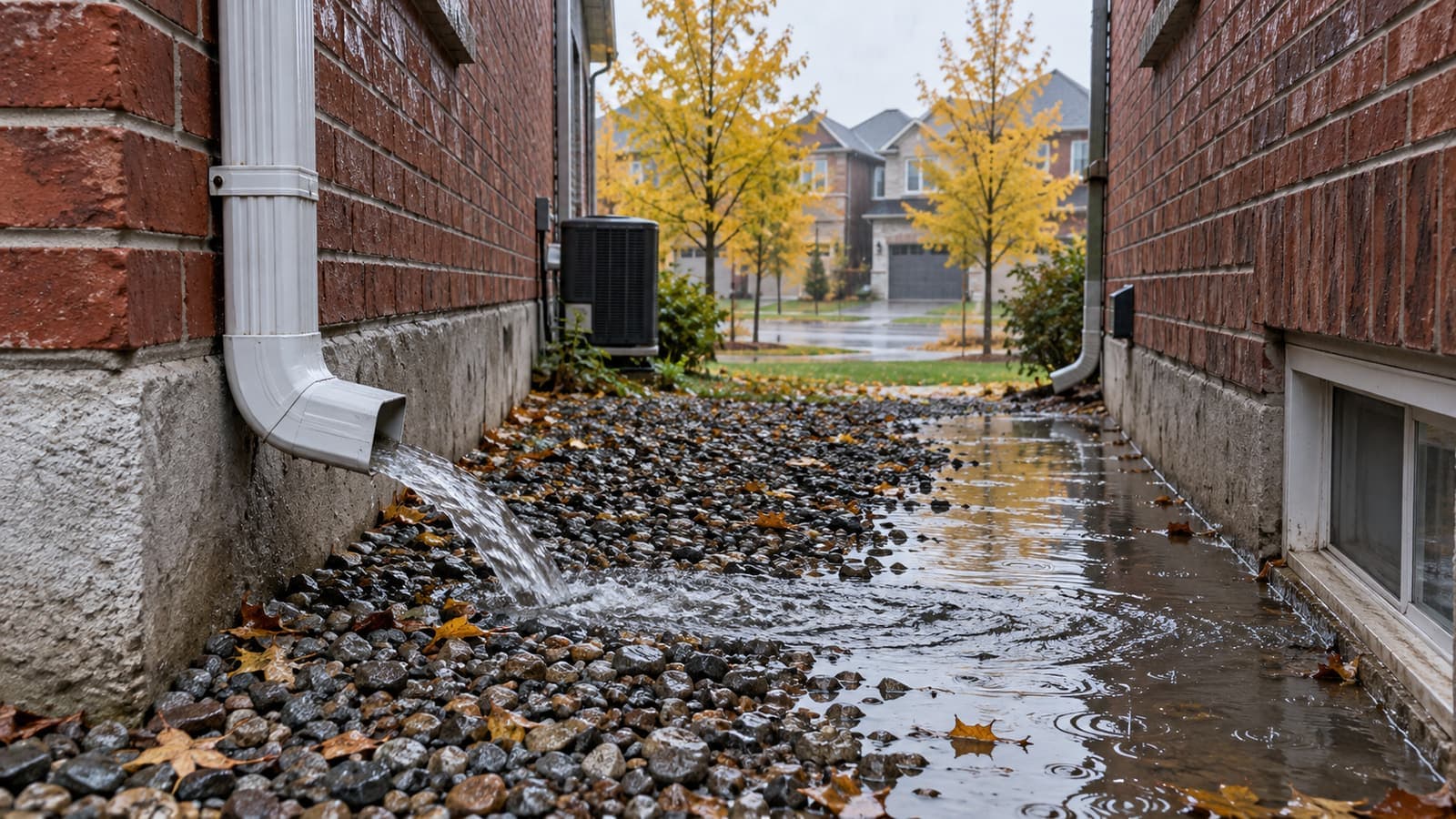
In most of the GTA, a neighbour's downspout is not allowed to dump roof water on your yard. Toronto's bylaw says downspout water must stay on the owner's property, and Brampton, Markham and Oakville bar draining roof water onto neighbouring land. Talk to your neighbour first; if nothing changes, call your city's by-law office. Damage claims are a civil matter.
Is it legal for a neighbour's downspout to drain onto your yard?
Usually not, when the downspout sends roof water straight at your lot. In Ontario, these rules sit in each municipality's property standards bylaw, passed under the Building Code Act, so the wording changes at every city line. Here is what six GTA bylaws say:
| City | Bylaw and section | What it says about roof water |
|---|---|---|
| Toronto | Chapter 629, § 629-20 C(2) | Above-ground downspout discharge must be contained on the property, not likely to damage any adjoining property or create a hazard on a stairway, walkway, street or boulevard. |
| Mississauga | By-law 0654-1998, s. 37(3) | A downspout not connected to a storm sewer must discharge at least 0.9 m (three feet) from the building, contained and directed within the property so neighbouring lands do not flood. |
| Brampton | By-law 165-2022, s. 15.2 | No roof drainage discharged, directed or channelled onto walkways, stairs or adjacent lands. |
| Markham | By-law 2017-26, s. 10(3) and 10(5) | Roof drainage must not be directly discharged on sidewalks, stairs or neighbouring property, and goes onto the ground at least 1.2 m from the building where physically possible. |
| Oakville | By-law 2023-074, s. 13(6) | No roof drainage onto an entranceway, walkway or stair, directly onto a neighbouring property, onto a road allowance, or in a way that will penetrate or damage a building. |
| Burlington | By-law 28-2009, s. 3.5.3 | A downspout not connected to a storm sewer discharges at least 0.6 m from the building, or a distance the officer accepts, along an acceptable flow path away from the property. |
Peel Region's downspout guidance for Mississauga and Brampton says it in plainer words: extend downspouts at least 2 m (6 ft) from the foundation, onto ground that slopes away, and do not let water drain onto a neighbour's property.
Toronto's wording is due to change. Council adopted a rewritten Chapter 629 in November 2025, and By-law 1512-2025, enacted that December, puts it into force on May 1, 2027. The new chapter still bars roof drainage that will penetrate or damage a building and keeps it off walkways, stairs and the road allowance.
Vaughan, Richmond Hill and the other GTA municipalities each have their own property standards bylaw, so check with your municipality before you quote a rule to anyone.
Why do cities call it a civil matter?
A property standards bylaw sets the minimum each property has to meet. It does not settle arguments between owners. Toronto's property standards page lists "water drainage onto a neighbour's property" among the civil matters the City cannot help with, next to boundary and fence disputes. Brampton's surface drainage guide says the City offers information and an inspection service to find the cause, but does not get involved in resolving disputes between neighbours.
That splits your problem in two. Whether a downspout breaks the local standard is a by-law question. Under Toronto's chapter, for example, an officer can issue an order listing the repairs and a deadline, and the City can do the work at the owner's expense if the order is ignored. Whether anyone pays for a soaked basement or a ruined flower bed is a separate question for the two owners, their insurers and, if it comes to that, a court.
How do you raise it with your neighbour?
Brampton's guide puts it simply: talking to your neighbour is the best first step, because they may not realize there is a problem. Go in with evidence and one easy ask.
- 1Watch it in a real rain. Film where the water leaves the spout and where it ends up, and note the date. Check whether it is the downspout, an overflowing gutter or runoff from their lawn, because each has a different fix.
- 2Check your own side. Look at your own downspouts and the slope of your yard; Toronto's bylaw, for one, expects every yard to be graded to carry surface water away from buildings. If water is reaching your basement, find the source first.
- 3Knock, show the video and make one specific request: turn the bottom elbow so an extension runs along their wall to the front or back, with a splash pad at the end. Offering to split the cost of the parts goes a long way.
- 4Follow up with a short, friendly email that confirms what you agreed and roughly when. Keep it with your photos.
- 5Give it two or three rains. If nothing has changed, or nobody answers the door, move on to the by-law office.
If the house next door is rented, ask the tenant to pass your request to the owner, since keeping a rental in good repair is the landlord's job. In a condo townhouse complex, the downspouts may be common elements, so the request goes to management: who looks after townhouse and condo gutters.
When should you call by-law or 311?
Call when talking has gone nowhere and the downspout is still sending water at your lot, wall, walkway or stairs. In Toronto, that is 311. In Markham, it is the By-law Enforcement and Licensing Department. Elsewhere, start with your city's by-law enforcement office or 311 line. Have this ready:
- The address, and which downspout: front or back corner, and which side of the house.
- Dated photos or video from at least one real rain.
- The bylaw section from the table above.
- Any damage you can see, such as a wet basement wall, a trench in the lawn or ice on a shared path.
What happens next is up to the officer. Toronto says officers review each complaint and, if it is validated, investigate, educate or take enforcement action, and it charges no fee for a complaint or an inspection. An order, if one comes, is about the repair. It will not compensate you.
For damage, start with your own insurer. Surface water coming in from outside usually needs optional overland flood coverage, and Brampton's guide warns that typical home insurance does not cover basement flooding from surface water. If you are weighing a claim against the neighbour, Ontario's Small Claims Court hears property damage claims up to $50,000, most claims must be filed within two years, and a lawyer or paralegal can tell you whether yours is worth making.
What fixes work for both houses?
Brampton's guide reckons nearly 1,000 litres run off an average house roof in a normal rainfall, so where each downspout points matters. The best fixes are cheap, quick and on the neighbour's own side of the line, and most come down to aiming the water at open ground that slopes away from both houses.
- Turn the bottom elbow so the extension runs along the house wall toward the front or back yard, instead of across the side yard.
- Make it long enough to reach open ground. Markham asks for 1.2 m from the building where physically possible and Peel suggests 2 m; in a narrow side yard, that distance gets measured along the wall.
- Finish with a splash pad, so the stream spreads instead of cutting a channel toward the lot line.
- Use a hinged, flip-up extension where the side yard is also the path to the back.
- Add a rain barrel if you like, with its overflow sent to the same safe spot.
- Move the drop. A downspout halfway along a narrow side may have nowhere good to go, and moving it to a front or back corner fixes that for good.
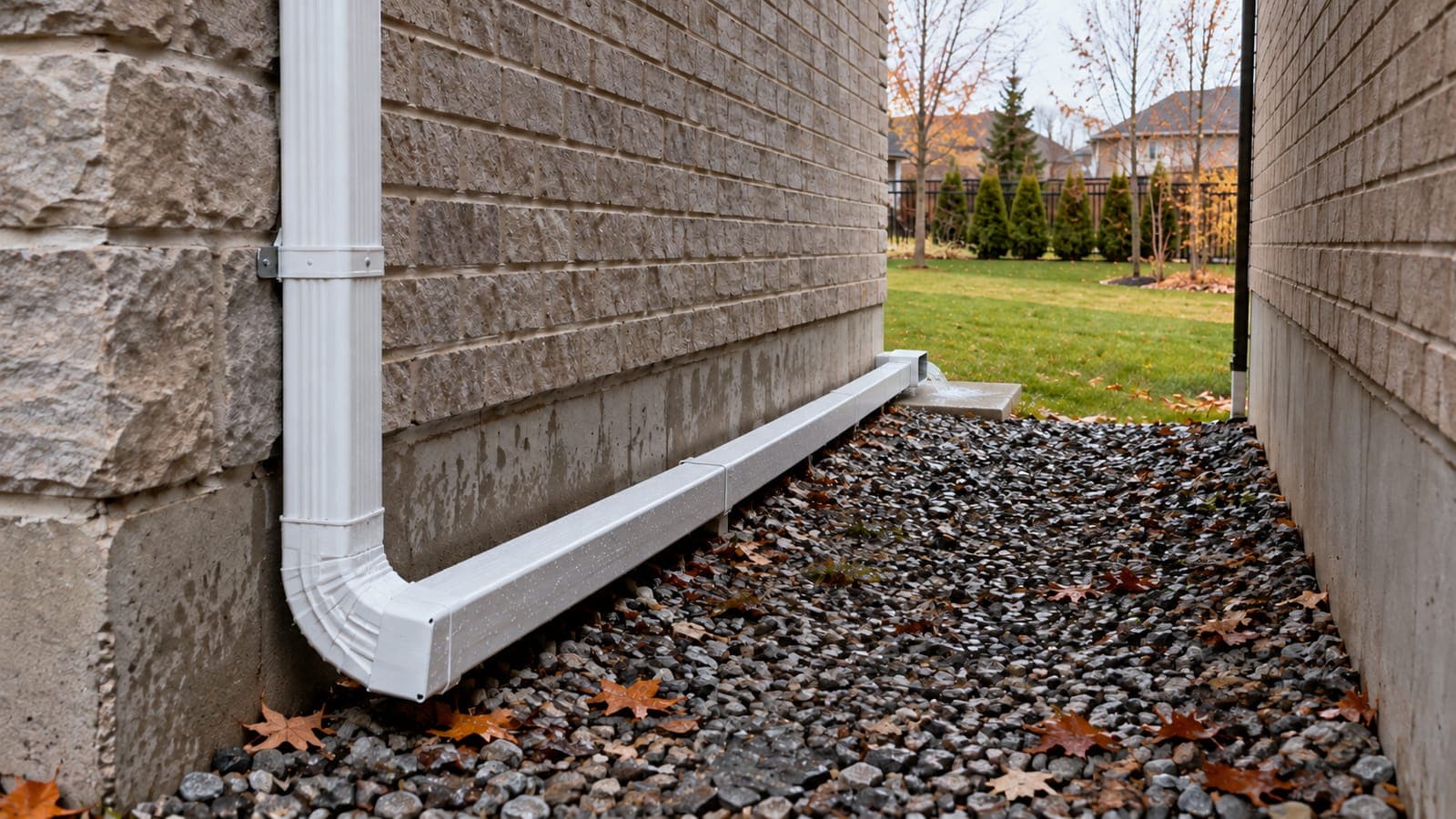
The downspout belongs to your neighbour, so the decision and the fix are theirs. The general rules for a good setup are in where downspouts should drain; the trick between two houses is applying them without handing the water to the other side.
What if the downspout empties into the gap between your houses?
A side yard a metre or so wide is the hardest spot, because a downspout there is close to two foundations at once. Markham's lot grading criteria call for clear stone instead of sod where the combined side yards between two buildings are 1.2 m or less, and use shallow side-yard swales, 150 to 250 mm deep, to carry water toward the street or a rear catch basin. Water from both lots running along that gap can be exactly what the grading plan intended. A spout aimed across it, at the other wall, is the problem.
So send the water along the swale, not across it. Keep the stone clear of leaves and silt so it drains, and keep both houses' downspouts flowing, because a clogged elbow spills at its joints right into the gap. Brampton's guide also warns against raising a swale or building anything in it, such as a shed or a raised bed, because that can disrupt the flow for the neighbours as well.
A shaded gap stays cold, so water pooling there freezes in the first cold snaps. Downspout ice on driveways and walkways covers that side of it.
What does this look like in Markham?
Cornell and Wismer show the problem at its tightest: dense two-storeys and laneway lots where homes share tight lot lines and a downspout often exits about a metre from two foundations. Markham's bylaw asks for discharge at least 1.2 m from the building "where physically possible", and the City's property standards page suggests a paved channel or an extension along the ground. In a gap that narrow, along the wall is the only direction that works.
In Unionville and Old Markham Village, the trouble is often upstream. Willows near the Rouge tributaries shed fine, whippy debris that wraps into elbows, and a packed elbow backs water up until it spills from a joint or over the gutter edge, landing beside the house whatever the extension says. Before blaming the aim, check the spout actually runs: how to unclog a downspout. For a property standards question, Markham's page points to the By-law Enforcement and Licensing Department at 905-479-7782.
Every cleaning we do ends with a downspout flush, an end-to-end flow test and a check of where each spout discharges. If the water is heading for a foundation or the lot line, the crew adds or re-aims an extension on the same visit. Downspout service in Markham comes with a cleaning at $349 for a two-storey townhouse or $399 for a two-storey detached home, before HST in 2026. Moving a downspout to a new corner is new downspout supply and installation, quoted separately. If the spout in question is next door, the booking is your neighbour's to make.
Sources
- Toronto Municipal Code Chapter 629, Property Standards (PDF)
- City of Toronto: Property standards
- City of Toronto By-law 1512-2025, new Chapter 629 (PDF)
- Mississauga Property Standards By-law 0654-1998 (PDF)
- Brampton Property Standards By-law 165-2022 (PDF)
- City of Brampton: Residential surface drainage problems (PDF)
- Markham Property Standards By-law 2017-26, consolidated (Word document)
- City of Markham: Property standards
- City of Markham: Engineering design criteria, lot grading (PDF)
- Oakville Property Standards By-law 2023-074 (PDF)
- Burlington Property Standards By-law 28-2009 (PDF)
- Region of Peel: Disconnecting your downspout
- Government of Ontario: Suing someone in Small Claims Court
Frequently asked questions
Can my neighbour's downspout point at my house?
Not in most of the GTA. Toronto requires downspout water to be contained on the owner's property without likely damage to adjoining property, Brampton bans roof drainage onto adjacent lands, and Markham and Oakville bar discharge directly onto a neighbouring property. Ask for the elbow to be turned first, and check with your municipality if it stays.
Who do I call if my neighbour's downspout floods my yard?
Your neighbour first, with dated photos from a real rain and one specific ask. If nothing changes, call the by-law office: 311 in Toronto, the By-law Enforcement and Licensing Department in Markham, or your own city's office elsewhere. For damage, call your insurer.
Is my neighbour liable if their downspout floods my basement?
Possibly, but that is a civil question, not a by-law one, and insurers, lawyers and the courts decide who pays. Ontario's Small Claims Court hears property damage claims up to $50,000, most claims must be filed within two years, and a lawyer or paralegal can tell you whether a claim makes sense.
What if a downspout empties into the narrow gap between our houses?
Run the water along the gap, not across it. Turn the elbow so an extension follows the wall to the front or back, finish with a splash pad, keep the side-yard stone or swale clear, and never raise or build in a shared swale. If there is no way out, moving the downspout to a corner is the lasting fix.
Can I move my neighbour's downspout myself?
Not without their permission. The downspout is part of their house, and changing it, or reshaping the ground so the water runs back at them, can start a second dispute. Ask, offer to share the cost of an extension, and confirm what you agree in a short email.
Keep reading
- Where should your downspouts actually drain?
- Are eavestroughs required? GTA property standards bylaws
- Neighbour's tree filling your gutters? Ontario rules
- Downspout services: what is included and how it works
- Downspout cleaning & unclogging in Markham: local prices and booking
- Everything we do in Markham: neighbourhoods, trees and services