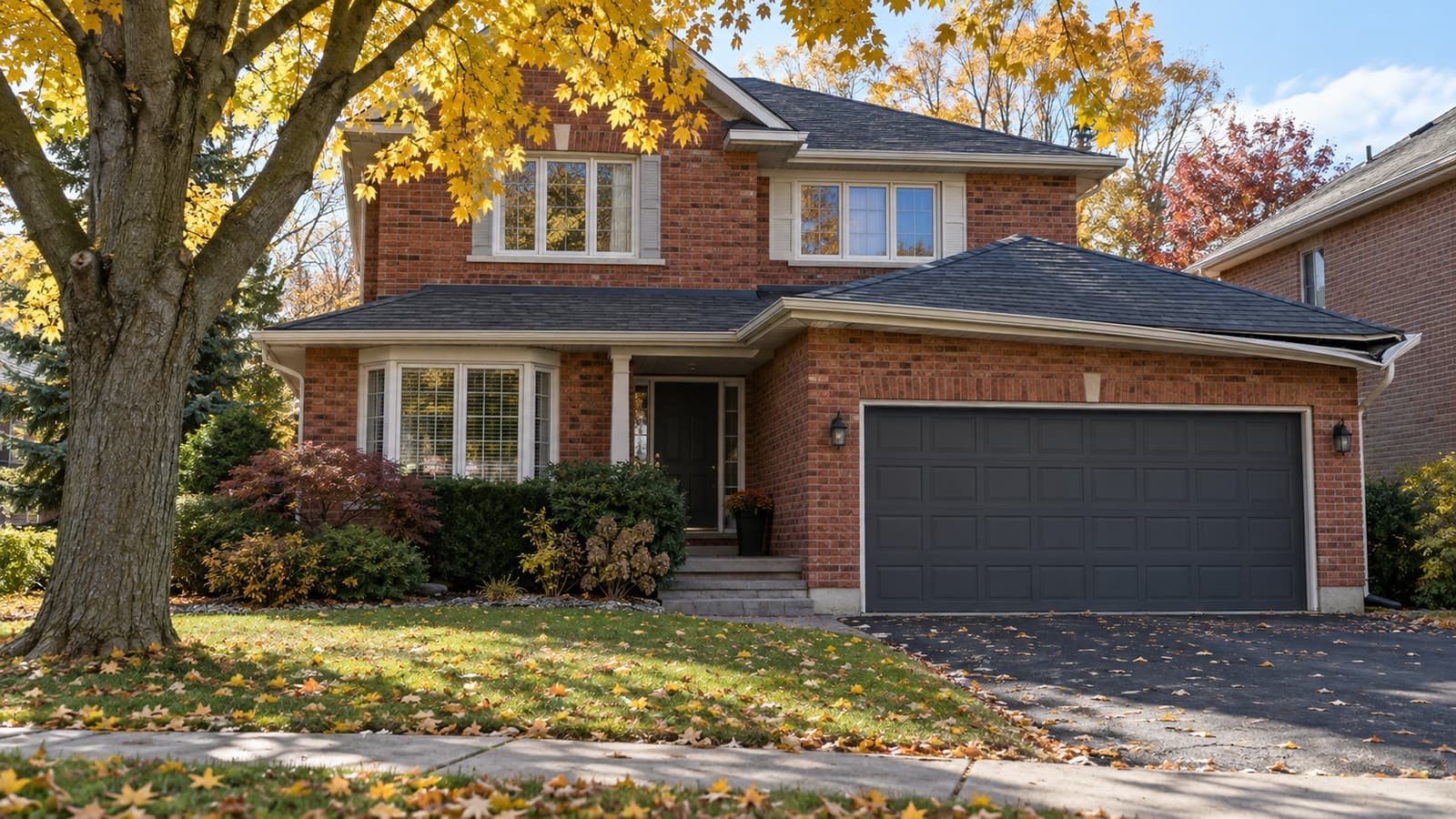
There's no single Ontario rule for existing homes, so your city decides. In Toronto, the property standards bylaw says roof water must run into an eavestrough and downpipe unless a rain-water collection system handles it, and every eavestrough must stay free of leaks, defects and obstructions. Mississauga's by-law makes eavestroughs the default too.
Does Ontario law require gutters on a house?
Not province-wide. Ontario's Building Code Act lets each council pass a property standards by-law, and that's where eavestrough rules live, so the answer depends on your address.
New homes vary too. Tarion's warranty guideline for eavestroughs opens with "Where provided", so it sets a standard for the ones a builder installs rather than requiring them; the Tarion guide covers the warranty side.
GTA cities differ in how hard they lean. Toronto and Mississauga write the eavestrough in as the default for roof drainage. Markham's rule applies only "where eavestroughs, roof gutters and downspouts are installed". Every by-law in this guide expects the eavestroughs you do have to be kept in repair.
What does Toronto's bylaw require today?
Municipal Code Chapter 629, section 629-20 C(1), says that where a rain-water collection system is not provided, the drainage from all roof surfaces of buildings shall discharge into an eavestrough or roof gutter and then into a downpipe. The downpipe empties into the building drain or not more than 150 millimetres (about 6 inches) above grade.
Subsection D covers upkeep: every eavestrough, roof gutter, flashing and downpipe must be maintained free from leaks, defects, obstructions and hazards, water-tight and in good repair. On the plain words, a trough packed with October leaves is obstructed, and a run hanging off its hangers is both a defect and a hazard. Section 629-5 puts that duty on the owner.
The water then has to stay on your property without damaging a neighbour's or creating a hazard on stairs or walkways. When a neighbour's downspout floods your yard covers disputes, and Toronto's disconnection bylaw covers the sewer side.
What changes when Toronto's new Chapter 629 starts in May 2027?
Council replaced the whole chapter with By-law 1512-2025, enacted December 17, 2025 and in force May 1, 2027. Until then, today's wording applies. The eavestrough clauses change like this:
- Required (section 629-4.3 C): all roofs of buildings and structures drain into an eavestrough or roof gutter, except building types for which the current Building Code doesn't require them.
- Downspouts (section 629-4.3 D): discharge away from the building, into a rain-water collection system, a building drain, or not more than 15 centimetres above grade.
- Upkeep (section 629-4.8 D): good repair, free from leaks, unsecured or unsafe objects and materials, and obstructions.
Which building types that exception reaches is a Building Code question. If you plan to remove or skip an eavestrough on a house, garage or shed after May 2027, ask the City through 311 first.
What do other GTA cities require?
Every city words it differently. These clauses come from the consolidated by-laws each city posts; amendments happen, so check with your municipality. For Vaughan, Richmond Hill or any town not listed, read its own by-law rather than borrowing a neighbour's.
| By-law | What it says | Required? |
|---|---|---|
| Toronto, Chapter 629, s.629-20 | Roof drainage into an eavestrough and downpipe; free from leaks, defects, obstructions and hazards | Yes, unless a rain-water collection system is provided |
| Mississauga, 0654-1998, s.10(3) and s.37 | Roof run-off into an eaves trough; secured, free of rust, watertight, in working order | Yes, unless the roof is designed so runoff causes no deterioration or nuisance |
| Brampton, 165-2022, s.20.1 | Eavestroughs and downpipes in Good Repair: clean, safe, functional and free from defects | Maintained |
| Markham, 2017-26, s.10(6) | Good repair, free from leaks, securely fastened to the building | Maintained where installed |
| Oakville, 2023-074, s.12(5) and s.13(4) | Metal eavestroughs in good repair and free from rust; the roof kept clean and free from debris | Maintained |
| Burlington, 28-2009, s.3.5.2 and s.3.5.4 | Good working order and free from health hazards | Maintained; not required where the roof is designed so runoff causes no deterioration or nuisance |
| Pickering, 7887/21 | Roofs, eaves troughs, gutters and downspouts in a state of good repair | Maintained |
Brampton's definition is worth a second read: Good Repair means "clean, safe, functional, and free from defects", so a trough doesn't have to be broken to fall short. The City's property standards fines page lists $250 for a first offence under section 20.1, rising to $750 for subsequent offences.
Do garages, sheds and porches need gutters?
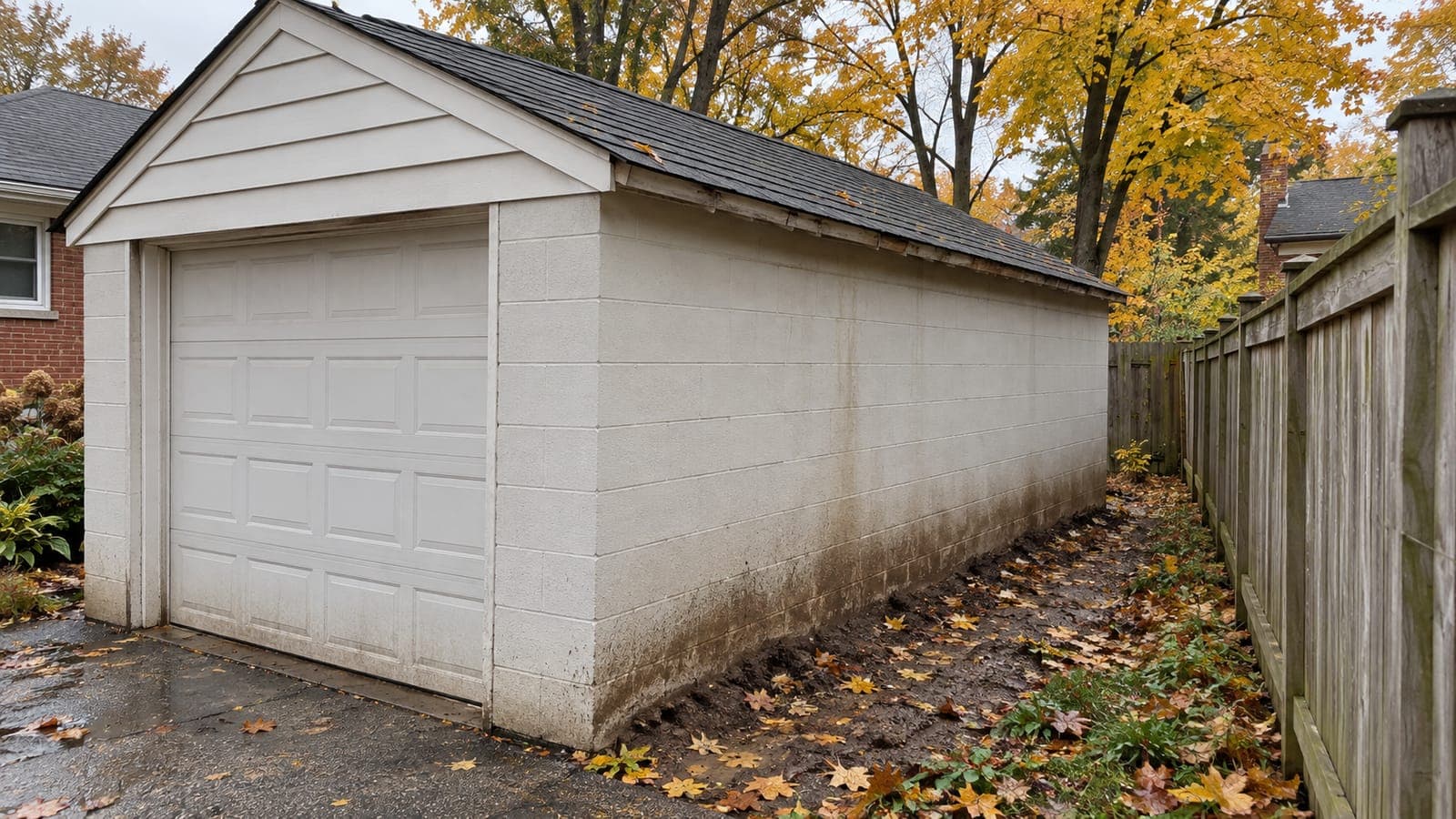
Toronto's current wording covers "all roof surfaces of buildings" with no carve-out for a detached garage, so ask the City before assuming yours is exempt. Mississauga and Burlington exempt roofs designed so runoff causes no deterioration or nuisance, and Markham only governs eavestroughs that are installed. Beyond the wording, judge by where the water lands:
- Against a foundation or slab: an eavestrough and a downspout extension earn their keep.
- Over the lot line or against a neighbour's fence: expect a complaint.
- Onto steps, the classic porch-roof problem: Brampton, Markham and Oakville bar roof drainage onto stairs, Toronto bars discharge that creates a hazard there, and in winter it turns to ice. A short eavestrough with the downspout aimed away usually fixes it.
- Onto open lawn well away from anything, where your by-law allows it: a small shed may manage without one.
How do you report a neighbour's broken eavestrough?
- 1Start with a friendly word. The owner may not have noticed, especially if the loose run is at the back of the house.
- 2Keep a record from your own side of the fence: dates, and photos taken in rain. Never climb onto a neighbour's roof or lean a ladder on their gutter.
- 3If nothing changes, call 311 in Toronto or Mississauga (905-615-4311 from outside Mississauga), or your town's by-law office.
- 4An officer reviews the complaint and, if it is valid, can educate, order repairs or fine. Toronto lists a $750 set fine for failing to comply with a standard and $1,000 for failing to comply with an order. In Mississauga, a final and binding order can be registered on the property's title.
- 5Keep damage separate: Toronto lists water drainage onto a neighbour's property among the civil matters the City cannot help with.
Renting? Tell your landlord or property manager first; Toronto's guidance is to contact 311 if it isn't resolved in a timely manner. The landlord and tenant guide has the rest.
What does this mean in Mississauga?
Mississauga's by-law sets two upkeep standards for eaves troughs: section 10(3) wants them secured, free of rust and serviceable, and section 37(2) wants them watertight, free from leaks and in working order. Those words map neatly onto the two repair problems the city's housing tends to produce.
In the newer blocks of Meadowvale and Erin Mills, long runs lose their pitch as the build settles, so water pools mid-span and spills over in a storm. Under the silver maples and oaks of Lorne Park, Port Credit and Clarkson, heavy wet debris pulls hangers loose and opens seams. On townhouse blocks, one blocked elbow on a shared run can back water across three units, and in a condo your declaration decides who fixes it.
Most of these are minor fixes, not new eavestroughs. Gutter repair in Mississauga covers re-fastening hangers, sealing small leaks and re-levelling short runs, priced on site from $89 in 2026, and the crew tells you plainly when a run is past saving (repair or replace explains that line). A cleaning on the same visit is $349 for a two-storey townhouse or $399 for a two-storey detached, before HST and with before and after photos of every run. Taking guards off and putting them back adds $40.
Frequently asked questions
Is it illegal to not have gutters in Ontario?
Not province-wide; your city's property standards by-law decides. Toronto's requires roof water to drain into an eavestrough and downpipe unless a rain-water collection system is provided, and Mississauga's requires them unless the roof is designed so runoff causes no deterioration or nuisance.
Is a clogged gutter a bylaw violation in Toronto?
It can be. Toronto's Chapter 629 says every eavestrough must be maintained free from leaks, defects, obstructions and hazards. Enforcement usually starts with a complaint to 311, and an officer can order repairs or issue a fine.
Do I need gutters on my detached garage or shed?
It depends on your city and where the water lands. Toronto's current bylaw covers all roof surfaces of buildings, while Mississauga and Burlington waive eavestroughs for roofs designed so runoff causes no deterioration or nuisance. Water hitting a foundation, a neighbour's lot or steps makes the case for one.
Can I complain to the city about my neighbour's falling eavestrough?
Yes. In Toronto and Mississauga, call 311 to report a property standards problem. An officer can order the owner to repair it, but a claim for damage to your own property is a civil matter between neighbours.
Can I remove my eavestroughs to stop ice dams?
In Toronto, not under the current bylaw unless a rain-water collection system handles the roof water. It wouldn't fix the cause anyway: ice dams start when attic heat melts snow higher on the roof, which insulation and ventilation address.
Keep reading
- Toronto's downspout disconnection bylaw, explained
- Neighbour's downspout flooding your yard? GTA rules
- Gutter repair or replacement: how to tell which you need
- Gutter repair: what is included and how it works
- Eavestrough & gutter repair in Mississauga: local prices and booking
- Everything we do in Mississauga: neighbourhoods, trees and services