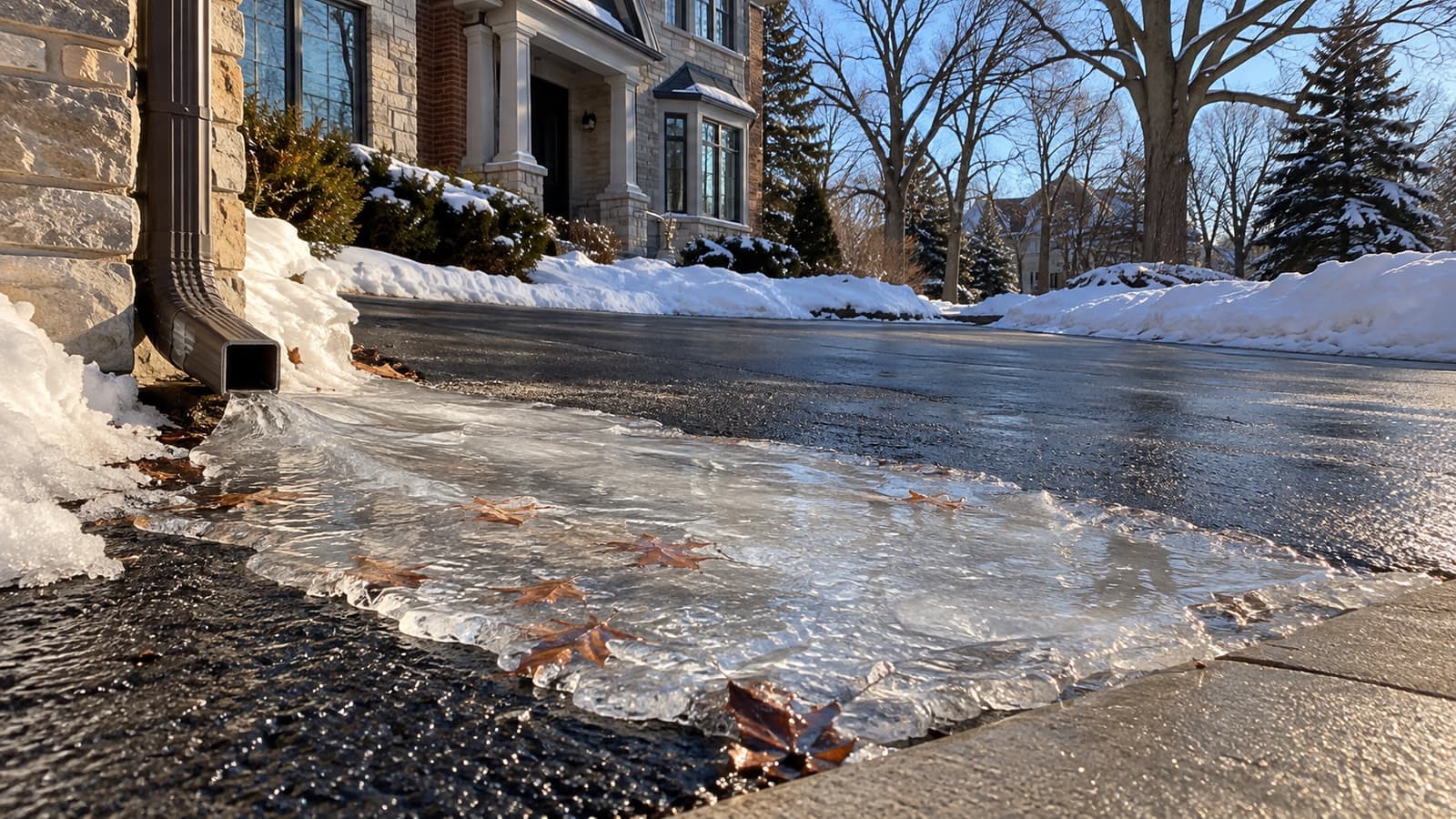
Downspout ice forms when meltwater from the roof runs across a driveway, walkway or step and refreezes overnight. The fix is to move the discharge, not to salt it harder: turn the elbow toward a lawn or garden, run an extension along the house to soft ground, or have a landscaper build a channel under the driveway.
Why does a downspout turn a driveway into ice?
Because the GTA lives around zero all winter. At Toronto Pearson, Environment and Climate Change Canada's 1991 to 2020 normals count about 131 days a year that dip to freezing or below, and only about 50 that stay below zero all day. That leaves roughly 81 days when the night freezes and the afternoon thaws. On each of them, sun on the shingles melts snow, the downspout carries the water to the ground, and if that ground is pavement the water spreads thin and freezes as soon as the light goes.
The ice builds in layers. Each melt adds a film, each night freezes it, and by February a downspout that ends at the edge of the driveway can lay down a sheet several metres long. Shaded, north-facing driveways and walkways get it worst, because the ice never gets a sunny afternoon to clear.
Is it against the rules to drain a downspout onto a walkway?
In several GTA cities it is, and everywhere else official guidance says not to. Property standards bylaws word it differently, but they point the same way:
| Where | What it says |
|---|---|
| Oakville | By-law 2023-074, s. 13(6): no roof drainage on an entranceway, walkway or stair, directly onto a neighbouring property or onto any road allowance |
| Brampton | By-law 165-2022, s. 15.2: no roof drainage discharged, directed or channelled onto walkways, stairs or adjacent lands |
| Markham | By-law 2017-26, s. 10(3): roof drainage must not be discharged directly on sidewalks, stairs or neighbouring property |
| Toronto | Chapter 629: above-ground discharge must not create a hazard on a stairway, walkway, street or boulevard |
| Peel Region | Downspout guidance: do not drain water onto asphalt or concrete |
| Mississauga | Rain-Ready Home Guide: avoid discharging across sidewalks or driveways, where water can freeze into ice |
The same bylaws usually bar sending the water onto a neighbour's lot, which is why the fix has to keep it on your own soft ground. Neighbour's downspout flooding your yard? covers the lot-line side of these rules city by city.
Who is liable if someone slips?
Homeowners in Ontario owe visitors a duty to keep the property reasonably safe, and ice on a front walk is the classic test of that duty. Since January 2021, section 6.1 of the Occupiers' Liability Act has added a deadline: a lawsuit for an injury caused by snow or ice cannot go ahead unless written notice, with the date, time and place, was served within 60 days of the injury, with exceptions for death and for a reasonable excuse.
That is a rule about claims, not a shield. This post is not legal advice, and if someone has already fallen, talk to your insurer or a lawyer. The cheaper path is prevention: a downspout that never puts water on the walk never puts ice on it.
How do you move the discharge off a driveway?
Do it in the fall, while the ground is soft and you can see where water goes in a rainstorm. In rough order of cost:
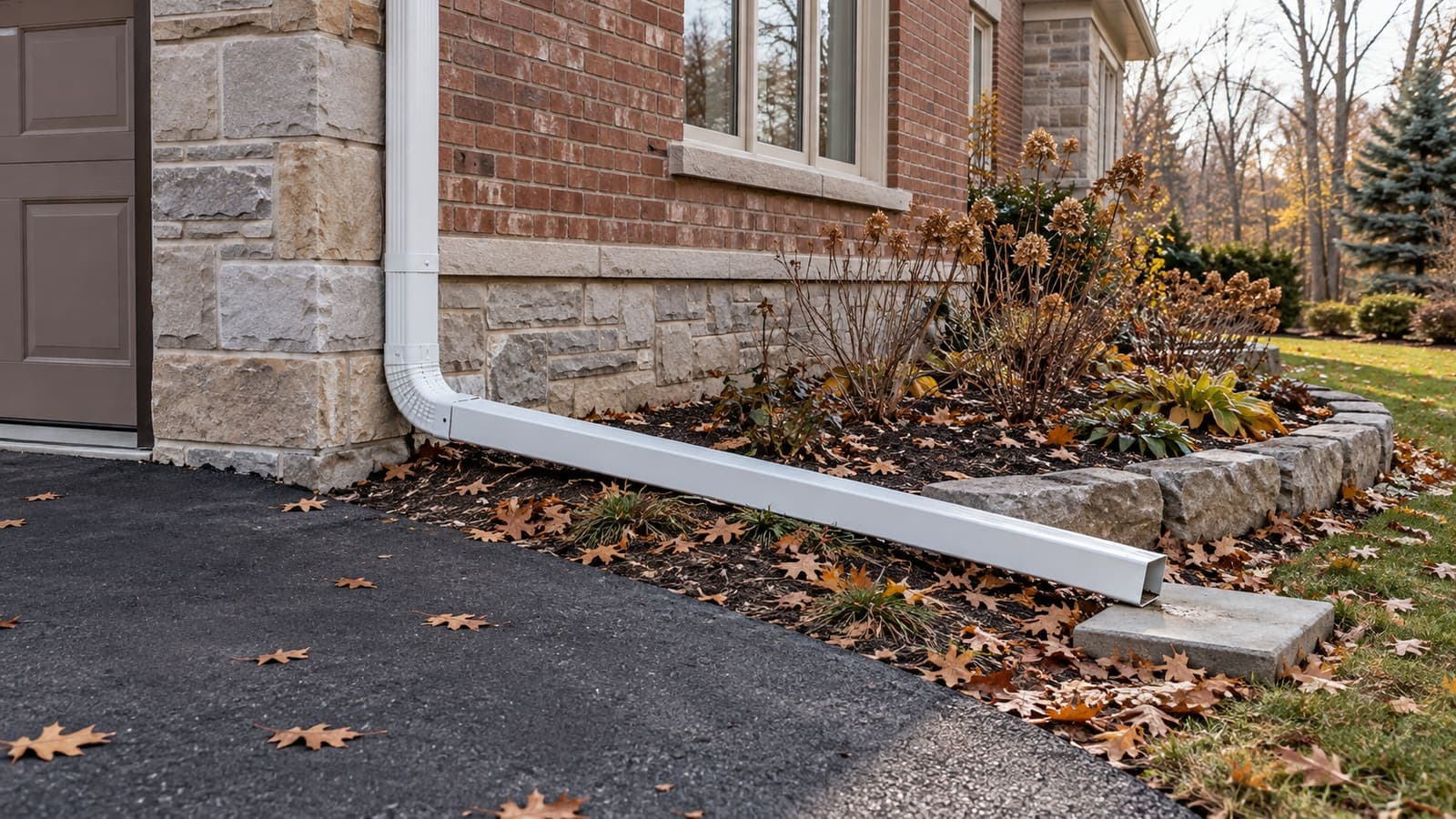
- 1Turn the elbow. Many downspouts can rotate their bottom elbow toward a lawn or garden bed instead of the pavement.
- 2Run an extension along the house. A downspout extension can follow the foundation to the nearest soft ground, ending on a splash pad that slopes away. Peel suggests at least 2 m from the foundation and Halton about 3 m.
- 3Use a hinged or roll-up extension where the path crosses a walkway, so it lies flat in rain and lifts out of the way for shovelling.
- 4Add a channel under the driveway. A covered trench drain or a pipe under the paving that daylights onto soft ground is landscaper or contractor work, and needs care so the outlet does not freeze shut.
- 5Never run it into an old standpipe in the ground. In Toronto that connection was cut off on purpose under the downspout disconnection bylaw, and in other cities it may still feed the sewers.
Should you leave downspout extensions on in winter?
Yes. Winter thaws send as much water down the spout as a fall rain, and without the extension it lands at the foundation. Mississauga's guide adds the winter catch: make sure the outlet is not buried in snow or ice, because a blocked outlet backs meltwater up the spout, where it freezes or spills from the joints. After each big snowfall, clear a pocket around the outlet and keep snowbanks off the extension.
If a downspout freezes solid anyway, do not chip at it. Frozen gutters and downspouts covers what is safe to do, and where downspouts should drain covers the year-round setup.
What if the ice comes from a leaking gutter, not the downspout?
Look up before you blame the spout. A steady line of drips from a seam, a corner or an overflowing run lands in one spot all day and freezes into a hump on the step below. That points to the gutter: a failed seal, a sag that holds water, or a trough that is still full of leaves. Why gutters leak at the seams and corners walks through the causes.
Small leaks and short sagging runs are minor repairs, from $89, priced on site and approved before any work starts. Fix them before the freeze and the drip line over the front step goes with them.
What does this look like in Oakville?
Oakville's stately two- and three-storey homes have steep hips and big perimeters, so a lot of roof drains to a few downspouts, often at the garage and the front entry, right where people walk. Oakville's own bylaw is one of the clearest in the GTA: no roof drainage on an entranceway, walkway or stair.
The trees add a twist. The oaks of Old Oakville and the creek corridors drop leaves and acorns into late November, and acorns are the local downspout-killer. A packed elbow going into the first freeze means meltwater backs up, spills at the joints and freezes against the wall or across the walk. In Glen Abbey, rear gutters that back onto the valley load all season.
Every cleaning we do ends with a downspout flush and a flow test, and the crew checks where each spout discharges and adds or adjusts an extension so water lands away from the house. Underground drains are a separate quote. Downspout service in Oakville comes with a cleaning at $399 for a two-storey detached home or $499 at three storeys, before HST in 2026; creek and valley lots add $20 for the extra hauling.
Sources
- Environment and Climate Change Canada: Toronto Pearson climate normals, 1991 to 2020
- Oakville Property Standards By-law 2023-074 (PDF)
- Brampton Property Standards By-law 165-2022 (PDF)
- Markham Property Standards By-law 2017-26, consolidated (Word document)
- Toronto Municipal Code Chapter 629, Property Standards (PDF)
- Region of Peel: Disconnecting your downspout
- City of Mississauga: Rain-Ready Home Guide (PDF)
- Halton Region: Flood preparedness and reducing your risk
- Ontario: Occupiers' Liability Act
Frequently asked questions
Should I remove my downspout extensions in winter?
No. Winter thaws send a lot of water down the spout, and without an extension it lands against the foundation. Keep the extension on, keep its outlet clear of snow, and route it so it does not cross a walkway.
Can I run my downspout under my driveway?
Yes, with a covered channel or a buried pipe that carries the water to soft ground on the far side. It is landscaper or contractor work, and the outlet must stay clear so the pipe does not freeze solid.
Am I responsible if someone slips on ice from my downspout?
Homeowners owe visitors reasonably safe premises, and an Ontario claim for a snow or ice injury needs written notice within 60 days. Speak to your insurer or a lawyer about a specific case; moving the discharge prevents the problem.
Why does ice keep building up at the bottom of my downspout?
Snow melts on the roof by day and the runoff refreezes at the outlet overnight. A clogged elbow or a buried outlet makes it worse, because the water backs up and freezes inside the spout and at its joints.
Keep reading
- Frozen gutters and downspouts: what to do this winter
- Where should your downspouts actually drain?
- Neighbour's downspout flooding your yard? GTA rules
- Downspout services: what is included and how it works
- Downspout cleaning & unclogging in Oakville: local prices and booking
- Everything we do in Oakville: neighbourhoods, trees and services