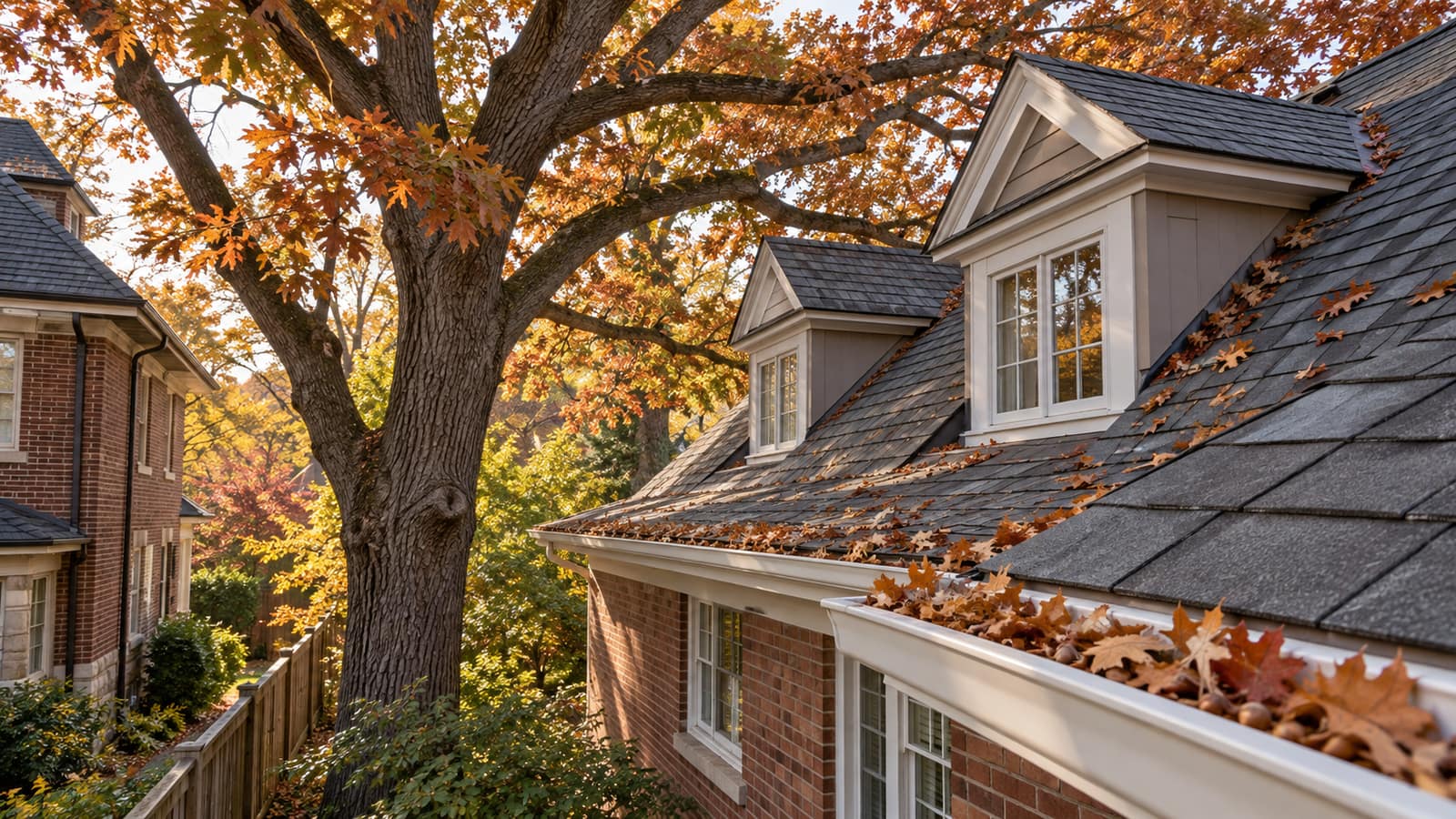
In Ontario, clearing a neighbour's leaves from your gutters is generally your job; Toronto's forestry staff call fallen leaves a maintenance matter for every owner. You can usually prune overhanging branches back to the property line without harming the tree, but a tree on the line belongs to both owners, and big trees need a permit to remove.
Who is responsible for leaves from a neighbour's tree?
You are, for the leaves that land on your side. In a 2020 report to North York Community Council, Toronto's Urban Forestry staff wrote that fallen leaves are a maintenance matter and the responsibility of all property owners. Mississauga's tree guidance is just as plain: overhanging branches, leaves and falling debris between properties are civil matters between neighbours, and the City will not investigate them.
Toronto's property standards bylaw (Chapter 629) says every eavestrough must be kept free from obstructions, with no exception for leaves from next door; what the bylaws require of eavestroughs has the detail. The tree's owner has duties too. The same bylaw requires dead, diseased, decayed or damaged trees and limbs to be removed or pruned. If a dead limb hangs over your roof, keep clear, tell your neighbour, and report a hazardous tree to 311.
Can you cut branches that hang over your roof?
Generally, yes: back to the property line, from your own side, without harming the tree. Mississauga's guidance says the part of a tree that crosses the property line may be pruned by the neighbour. You still need the owner's permission to work from their yard, and Toronto notes that a tree permit does not give anyone the right to enter another person's property.
In Toronto, pruning to good arboricultural practice needs no permit (Chapter 813, s.813-13B). Cutting that harms a private tree 30 cm or more across counts as injury, and injury needs a permit. For heavier work, the neighbour whose property the crown hangs over can apply; the City then writes to the tree's owner and shares the arborist report.
This is general information, not legal advice. A cut that kills a neighbour's tree can still end in a dispute, so for a valuable tree or an unhappy neighbour, get legal advice before any limb comes down.
What if the trunk is on the property line?
Then the tree belongs to both of you. Ontario's Forestry Act says a tree whose trunk grows on the boundary between adjoining lands is the common property of both owners (s.10(2)), and injuring or destroying it without the owners' consent is an offence (s.10(3)). A conviction carries a fine of up to $20,000, up to three months in jail, or both (s.19(1)).
Toronto's bylaw treats a tree as a boundary tree if any part of its trunk, which the bylaw measures from the roots up to where the tree branches out, grows across a property line. Any co-owner can apply for a permit, but the others must consent, and the City writes to each of them. Markham also requires the adjacent owner's consent for trees on or crossing a property line.
For your gutters, that makes pruning a shared tree a joint decision: agree on the work and the arborist in writing, and split the bill.
Can you remove a tree because it clogs your gutters?
Not because of leaves, as a rule, and never a tree that is not yours. Toronto, Mississauga, Markham and Oakville all require a permit to remove private trees above a set trunk size:
| Municipality | Permit needed | Measured at | Tape around the trunk |
|---|---|---|---|
| Toronto | 30 cm or more across, to injure or remove | 1.4 m above ground | About 94 cm (37 in) |
| Mississauga | 15 cm or more, to injure or remove, dead trees included | Check with the City | About 47 cm (18.5 in) |
| Markham | 20 cm or more, to injure or destroy | 1.37 m above ground | About 63 cm (25 in) |
| Oakville | Over 15 cm, to remove | Breast height | About 47 cm (18.5 in) |
To check a trunk, Toronto suggests wrapping a tape around it at 1.4 m and dividing by 3.14. Harming or removing a City street tree, which can stand on the boulevard in front of a house, needs a permit at any size, and so does any tree in a ravine or natural feature protection area. Other municipalities set their own rules, so check with yours before anyone cuts.
Leaves are a weak case even for your own tree. Toronto's bylaw tells staff not to issue permits for healthy trees outside listed exceptions, such as a tree causing or likely to cause structural damage to load-bearing or roof structures. In the 2020 report, staff recommended refusing removal of a healthy Norway maple over slippery leaves and a leaking foundation, and pointed to regular raking instead. On conviction, cutting a protected Toronto tree without a permit brings a fine of $500 to $100,000 per tree.
Who pays to clean gutters under a neighbour's tree?
In almost every case, you do. Nothing in these rules makes a neighbour pay for your gutter cleaning because their healthy tree sheds leaves. Water is different: a neighbour's downspout aimed at your yard has its own rules, covered in when a neighbour's downspout floods your yard.
Asking is still fair, and the best ask helps both houses:
- 1Confirm whose tree it is. Your survey shows the property line, and 311 can say whether a boulevard tree is the City's.
- 2Measure the trunk at 1.4 m, so you both know whether a permit applies.
- 3Bring photos. The before and after shots from a gutter cleaning show what came out of the runs under the tree.
- 4Make one specific ask, such as sharing an arborist's visit to prune limbs back from your roof.
- 5Put any deal about a shared tree in writing before work starts.
If the answer is no, the fix is still on your side of the line.
Which gutter guards handle a neighbour's oak or maple?
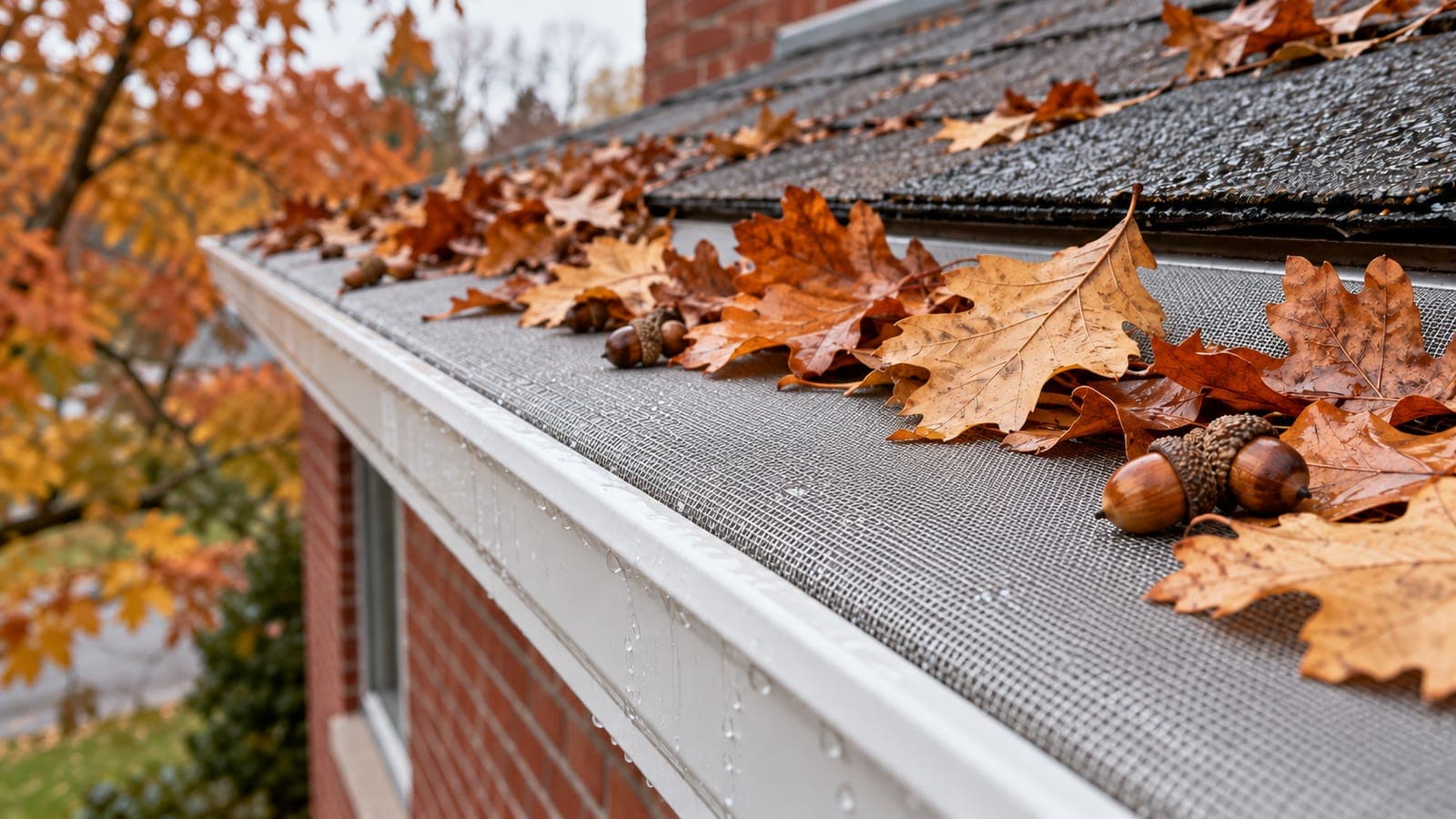
Fine stainless micro-mesh. Acorns and oak catkins slip through wide-slot screens, maple keys wedge in perforated holes, and foam and brush inserts break down in Ontario's freeze-thaw. A micro-mesh gutter guard keeps that mix on top of the trough, where wind and rain clear much of it. What each GTA tree drops, and when shows why oak lots are the hardest test.
You do not have to guard the whole house. The runs under the neighbour's canopy take most of the load, so start there. Guards cut how often you clean; they do not end it. Plan on a yearly check: how to clean gutter guards covers the routine, and are gutter guards worth it? compares every type.
What does this look like in Forest Hill?
Forest Hill puts this question under some of the biggest trees in Toronto. Mature oaks and maples tower over most streets, and lots near the Cedarvale and Nordheimer ravines take oak, maple and ash debris over the back fence as well (why ravine lots fill gutters faster). The maples drop from mid-October, the oaks hold on into late November, and the canopy adds acorns in fall and catkins in spring.
Trees that tower over two- and three-storey houses are usually well past Toronto's 30 cm line, so pruning is arborist work and removal is a long shot. If your lot backs onto a ravine, check the City's ravine protection map, explained on its tree and ravine permit page, before anyone cuts.
The houses make guards worth more here. Large 1920s and 1930s homes with steep roofs, dormers and deep valleys, some still with copper eavestroughs, mean long ladders on planned footing and standoffs so nothing leans on an old gutter. Every visit a guard saves is a big one.
Gutter guards in Forest Hill are measured and cut to each run, fitted after a full clean and flush, and quoted on site once the crew has seen your roof, gutters and trees. After that, a heavily treed lot adds $20 to a cleaning, and taking the guards off and putting them back adds $40. In 2026, standard detached homes are $399 at two storeys and $499 at three, large homes are $549 at two storeys, and three-storey estate homes get a custom quote, all before HST.
Sources
- Ontario Forestry Act, R.S.O. 1990, c. F.26
- Toronto Municipal Code Chapter 813, Trees (PDF)
- Toronto Municipal Code Chapter 629, Property Standards (PDF)
- City of Toronto: When to apply for a tree or ravine permit
- City of Toronto: Urban Forestry report, February 20, 2020 (PDF)
- City of Toronto: Storm damage to trees
- City of Mississauga: Caring for trees on your private property
- City of Markham: Tree permit application
- Town of Oakville: Private tree protection
- Toronto Hydro: Vegetation management
Frequently asked questions
Is my neighbour responsible for cleaning my gutters if their tree fills them?
Generally no. Toronto's Urban Forestry staff call fallen leaves a maintenance matter for all property owners, and Mississauga treats leaves between properties as a civil matter it will not investigate. You can still ask a neighbour to share the cost of pruning.
Can I trim my neighbour's tree branches without asking in Ontario?
Generally you can prune branches back to the property line from your own side, as long as the cut does not harm the tree. Asking first is still wise: a heavy cut on a protected tree needs a permit, and a tree on the line belongs to both owners.
Do I need a permit to prune a large tree in Toronto?
Not for pruning done to good arboricultural practice. Cutting that harms a private tree 30 cm or more across needs a permit, any work on a City street tree needs City approval, and harming any tree in a ravine protection area needs a permit.
Can I make my neighbour cut down a tree that drops leaves in my gutters?
Generally not. Leaves count as ordinary maintenance, and in Toronto a tree 30 cm or more across needs a permit to remove, which staff are told not to issue for healthy trees outside listed exceptions. Fine mesh guards on the runs under the canopy are the practical fix.
Keep reading
- Maple keys, catkins, acorns: a GTA gutter debris field guide
- Gutter guards in the GTA: worth it or not?
- Neighbour's downspout flooding your yard? GTA rules
- Gutter guard installation: what is included and how it works
- Gutter guards & eavestrough covers in Forest Hill: local prices and booking
- Everything we do in Forest Hill: neighbourhoods, trees and services