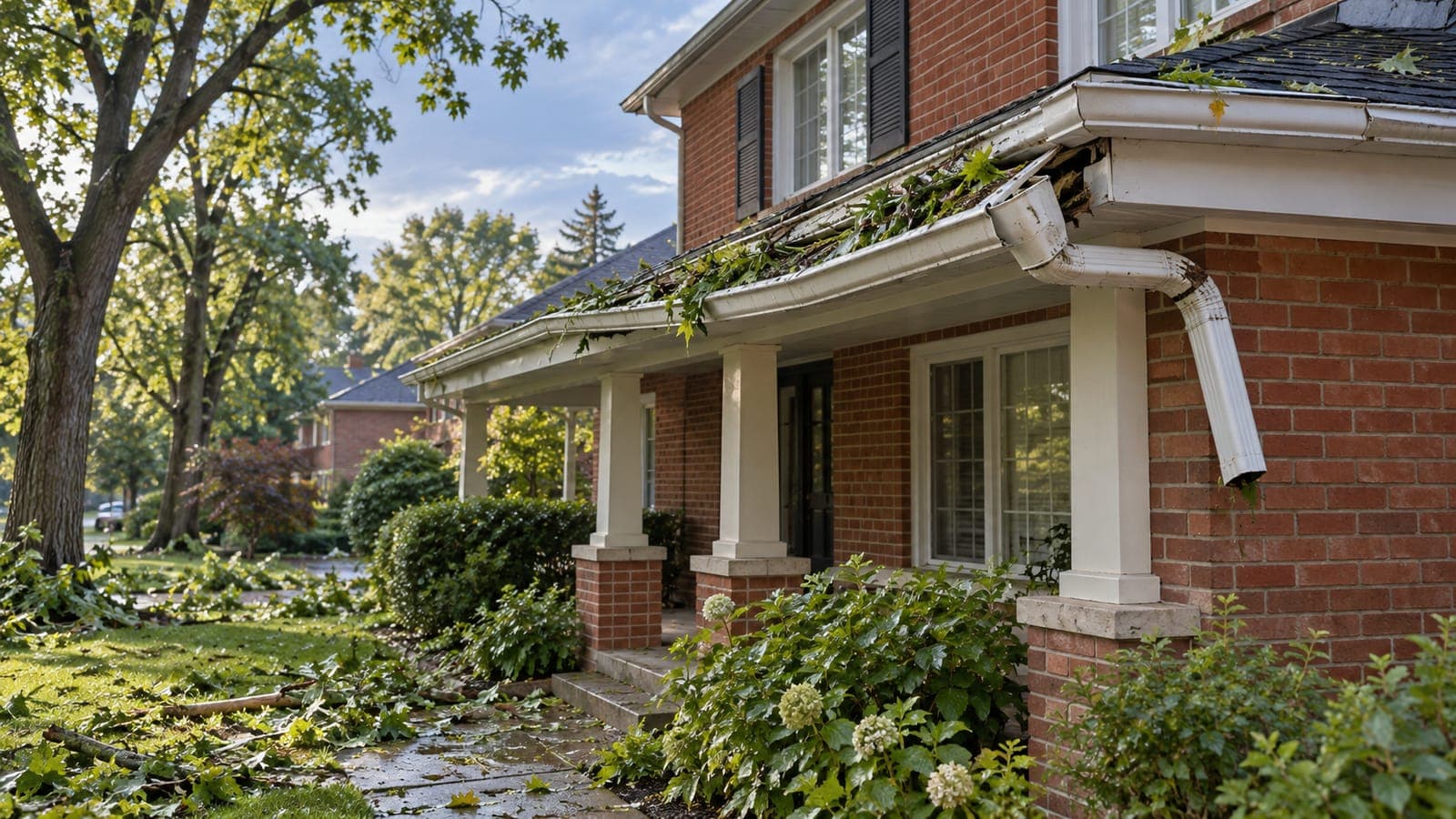
After a storm, check your eavestroughs from the ground before anyone climbs. Look for sagging runs, gaps at the fascia, hail dents, downspouts knocked loose at the elbows, and branches or leaf mats in the trough. Photograph everything, stay 10 metres from any downed wire, and get loose hangers fixed before the fall leaves add weight.
What did the September 2 storm do to GTA gutters?
Environment Canada's preliminary figures for the September 2, 2026 storm, reported by CP24, had 133.0 mm of rain in Vaughan, 118.1 mm in North York and 105.9 mm in Scarborough, hail of 2.5 to 6.5 cm (1 to 2.5 inches) in North York, and 83 km/h winds at Pearson, though Environment Canada noted that its radar estimated winds of more than 130 km/h. Toronto's city manager said the rainfall qualified as a '100-year storm'.
Wind pries loose runs off the fascia, hail dents and crimps, and falling limbs crush. Then the water: every millimetre on a square metre of roof is a litre, so a roof with a 100-square-metre footprint (about 1,075 sq ft) sends roughly 11,800 litres, close to 12 tonnes, through its gutters in a 118 mm storm. In a cloudburst, even clean gutters overflow.
Water in the basement too? Here is how to find the source.
What should you check from the ground?
Mississauga's Rain-Ready Home Guide puts it simply: 'A quick walk-around after big storms can catch a loose or blocked downspout before it causes a problem.' Once the wind drops, walk all the way round and photograph as you go.
- 1Look up for hazards first: a wire down or sagging, a limb on the roof, a branch caught in the line to the house. If you see one, keep back; for a downed line, call 911 and your utility.
- 2From each corner, look along the run for a dip, a twist or a section tilted outward.
- 3Check where the gutter meets the fascia: daylight between them, or a hanger head sticking out, means the fasteners have moved.
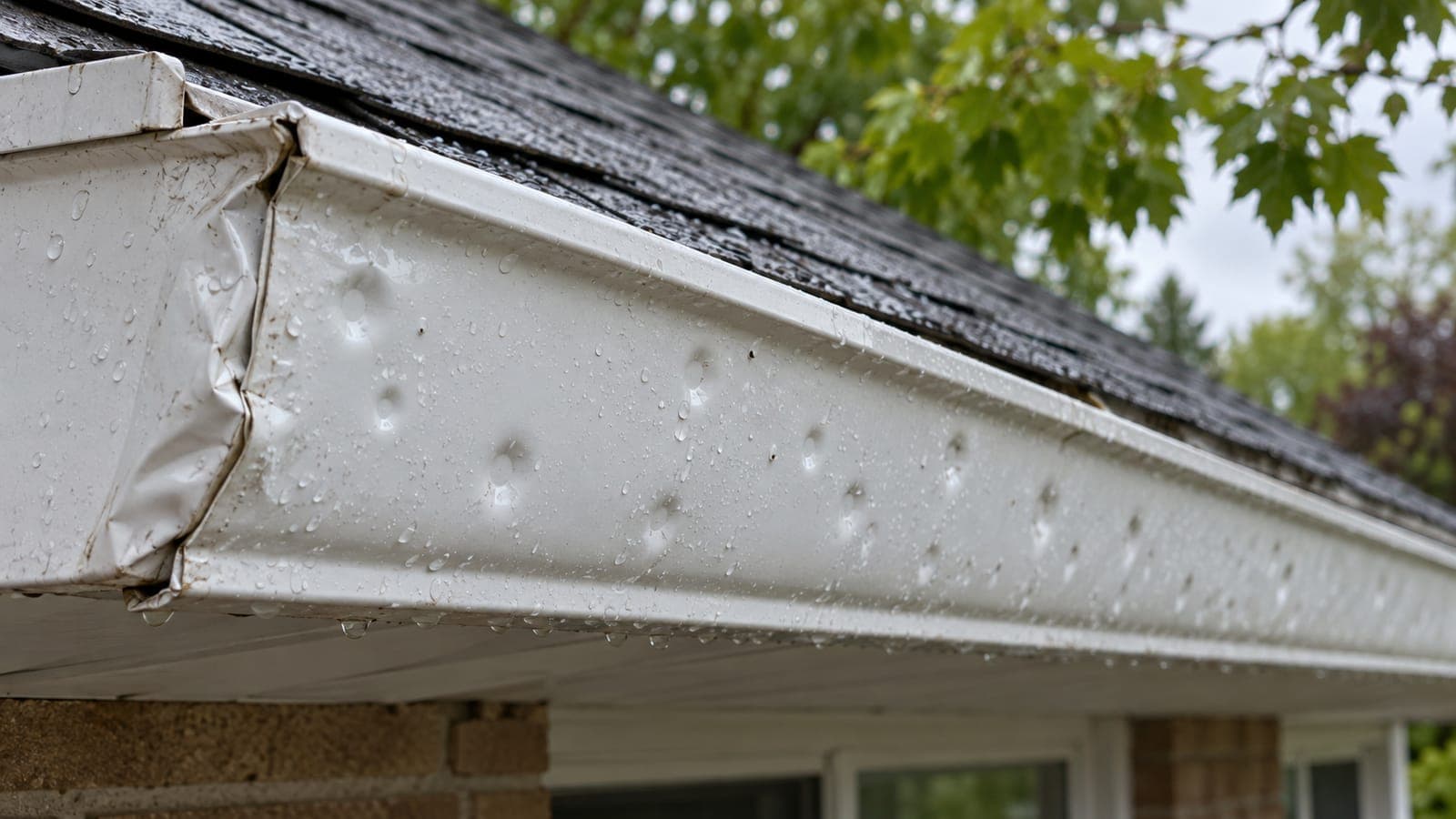
- 4Scan the face and corners for hail: rows of small round dents, a bent corner, an end cap knocked loose.
- 5Follow each downspout down: sections pulled apart at the elbows, straps torn off the wall, crushed pipe, extensions knocked aside.
- 6Look for branches across the trough, green leaves plastered over an outlet, and washed-out soil below.
- 7Watch the next rain. Every downspout should run full; a dripping seam, a waterfall at one spot or a silent spout is what the walk missed.
Can hail dent or crack gutters?
Yes. Most GTA eavestroughs are aluminum: light and rustproof, but soft. Hail like North York's, from loonie-sized to nearly tennis-ball-sized, can dent the face of a run and crimp its folded corners. Vinyl does not dent; a hard hit cracks it.
The test is whether the gutter still holds its slope and carries water. Face dents are usually cosmetic. A dent in the trough bottom holds water, and ice in winter. A crimped corner can open a seam, and a flattened outlet or downspout chokes the flow just as the leaves arrive.
Hail also knocks granules off shingles into the trough. A sudden load of dark grit is a reason to have a roofer check the roof; granules in the gutter explains why.
Is a storm-damaged gutter safe to leave?
Not for long. A run hanging off half its hangers is still carrying weight; wet October leaves will load what is left, and the first freeze turns water trapped in a dent or sag into ice. A loose section over a door or driveway can also fall, so keep people and cars clear until it is fixed.
In Toronto, North York included, the Property Standards bylaw (Municipal Code Chapter 629, section 629-20 D) says every eavestrough and downpipe must be maintained free from leaks, defects, obstructions and hazards. Other GTA cities word it differently, so check with your municipality; are eavestroughs required? compares them.
What is not a DIY job after a storm?
- Anything near a wire. The Electrical Safety Authority says to stay at least 10 metres (33 feet) from a downed line, assume it is live, and call 911 and your utility. Keep ladders 3 metres from overhead powerlines.
- A damaged service stack, the pipe where the hydro wire meets the house. Toronto Hydro lists it as customer-owned equipment that a licensed electrical contractor may need to repair before power is safely reconnected.
- Branches on the roof or hung up in a tree: an arborist for private trees, and 311 for storm-damaged City trees in Toronto.
- The roof, and any ladder work on a damaged run: wet shingles are slippery, and a loose gutter cannot take a ladder's weight.
From the ground you can still slip a fallen extension back on, reset the splash pads, rake leaves off the outlets and take photos.
Should you repair or replace a storm-damaged gutter?
Storm damage is often local: one section, one corner, one downspout. That is repair work; replacement is for metal wrecked along most of a run.
| Storm damage | Usual fix | More than a minor fix when |
|---|---|---|
| Hangers pulled loose | Re-fasten into sound wood, re-level | The fascia behind is soft or split |
| Run sagging or twisted by wind | Lift to a proper slope, add hangers | The metal is kinked along its length |
| Corner bent open and leaking | Straighten, re-rivet, reseal | The corner is torn or crushed |
| Section crushed by a falling limb | Splice in a matching piece | The damage runs most of the length |
| Downspout pulled apart or crushed | Reconnect, re-strap or swap the length | Rarely: lengths are simple to replace |
Repair or replace has the full decision table, and sagging gutters covers re-hanging a run. If you do replace, hail advice from the Institute for Catastrophic Loss Reduction, published by the Insurance Bureau of Canada, favours aluminum over vinyl, and heavy rolled steel for the most protection.
What should you do about insurance?
Your policy decides what is covered; insurance and gutters explains sudden damage versus wear and tear. The Insurance Bureau of Canada's guidance after the September storm is practical: once it is safe, photograph the damage, report it to your insurer or broker promptly, keep notes and keep cleanup receipts. A small repair may cost less than your deductible, so ask your broker before you file.
What does storm damage look like in North York?
North York got both halves of the storm: 118.1 mm of rain and hail of 2.5 to 6.5 cm. On the ravine-backing lots of Bayview Village, Don Mills and York Mills, storms strip oak and ash twigs and green leaves that pack downspout elbows weeks before the late-October drop. The big rebuilds in Willowdale and York Mills have long downspouts with more joints to pull apart, and rear runs nobody sees. Lansing and Newtonbrook bungalows are the quick check: one storey, a simple roofline, and older fasteners a storm load can finish off.
Gutter repair in North York handles the common storm fixes: re-fastening pulled hangers, sealing small leaks and re-levelling short sags. Minor repairs run from $89, priced on site and approved by you first. Add a cleaning and the storm debris goes at the same visit: in 2026, $339 before HST for a one-storey detached home or $399 for a two-storey, every downspout flushed, with before and after photos. If a run is past a minor fix, you hear that plainly.
Frequently asked questions
Can hail damage aluminum gutters?
Yes. Aluminum is soft, so large hail can dent the face of a run, crimp its corners and flatten downspouts. Face dents are usually cosmetic; dents that hold water, leaking corners and crushed downspouts need repair.
My gutter pulled away from the house in the storm. Can it be reattached?
Usually, if the metal is not kinked and the fascia behind it is sound: the run is lifted back to a proper slope and fastened with new hangers into solid wood. Soft or split fascia needs carpentry first.
Why are my gutters full of green leaves in September?
Wind and hail strip leaves and twigs from trees weeks before the normal fall drop, and fresh leaves mat flat over outlets. If they block an outlet, have it cleared now; otherwise they can wait for the late-fall clean.
Is it safe to clean my gutters right after a storm?
Wait until the wind drops, the roof and ground dry out and the utility has dealt with any damaged wires. Wet shingles, soft ground and loose gutter sections make the days right after a storm a bad time to climb.
Keep reading
- Sagging gutters pulling away from the house: why and fixes
- Does home insurance cover damage from clogged gutters?
- Water in the basement after rain: how to find the source
- Gutter repair: what is included and how it works
- Eavestrough & gutter repair in North York: local prices and booking
- Everything we do in North York: neighbourhoods, trees and services