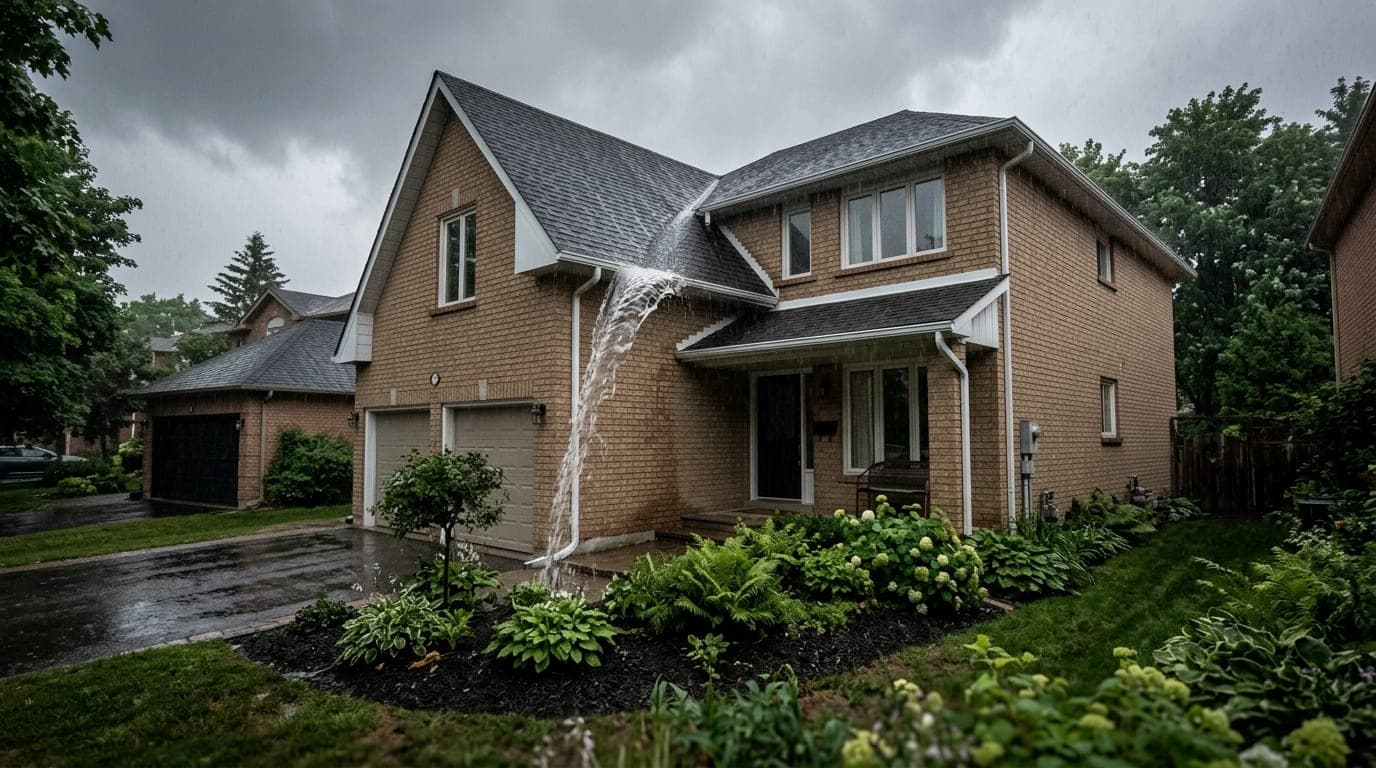
Clean gutters overflow for five main reasons: the run has lost its slope and water pools, a downspout or elbow is partly blocked, the gutter or spout is too small for the roof area feeding it, a roof valley dumps a torrent into one corner, or the rain is simply heavier than any residential gutter can take.
Where exactly does your gutter overflow?
The spill point is the diagnosis. Next time it rains hard, stand under an umbrella and note where the water leaves the gutter. Each location has a short list of causes.
| Where the water spills | Most likely cause | What fixes it |
|---|---|---|
| An inside corner under a roof valley | Valley water shooting past the gutter lip | A valley splash guard; sometimes a bigger gutter on that run |
| Right beside a downspout | Partly blocked outlet or elbow | Clear and flush the spout (how-to) |
| The middle of a long run | A sag or lost slope, so water pools at a low point | Re-fasten hangers and re-pitch the section |
| Along the whole length at once | Gutter or spout undersized for the roof, or extreme rain | Add a downspout or upsize the run |
| Behind the gutter, down the fascia | A gap at the roof edge or a missing drip edge | See water running behind gutters |
Could the downspout be the hidden problem?
Very often, yes. A gutter can be scooped perfectly clean and still overflow because the leaves that were in it washed down and wedged in the first elbow. From the ground you would never know. The tells are a spout that runs weakly in heavy rain and a dull thud instead of a hollow ring when you tap it. Flushing each downspout with a hose after a cleaning is the only way to be sure, which is why a flow test belongs at the end of every cleaning.
Has the gutter lost its slope?
An eavestrough should fall toward its outlet by roughly 1 to 2 millimetres per metre, too little to see from the street. Over the years, freeze-thaw cycles back hangers out of the fascia, ice and wet leaves add weight, and a ladder leaned against the gutter bends it. The run develops a belly, water collects in the low spot, and in heavy rain it spills there first.
The check is easy: a day after rain, look for standing water in a clean gutter. More than about a centimetre sitting in one stretch means a low spot. How to check and restore the pitch walks through it, and it is usually a small fix: re-fastening a few hangers at the right height.
Is your gutter too small for the roof?
Most GTA houses were built with 5-inch K-style eavestroughs and 2-by-3-inch downspouts. That handles a typical roof, but some rooflines concentrate water: a large, steep roof plane draining to a single corner, an upper roof whose downspout empties onto a lower roof, or a long run with one outlet at the far end. Newer two-storeys with busy rooflines, like many in Markham's Cornell and Wismer, are prone to exactly this.
- Add a downspout. Two outlets on a long run halve the load on each, and it is often the cheapest fix.
- Upsize the downspout to 3-by-4 inches, which doubles the opening and clears debris more easily.
- Move to 6-inch gutters on the run that overflows, if the first two do not solve it. Sizing explained.
- Extend an upper-roof downspout down to the lower gutter's outlet, or across the lower roof, instead of dumping it mid-run.
What about roof valleys?
A valley is where two roof planes meet, and it gathers the water from both. In a downpour that water hits the gutter corner fast enough to jump the outer lip. The fix is a small valley splash guard: an L-shaped piece of aluminum on the gutter lip at the corner that knocks the stream back into the trough. Keeping the valley itself clear of leaves matters too, because a leaf dam in a valley sends water sideways. Why roof debris matters covers that.
Can a gutter just be overwhelmed by rain?
Yes, and it is worth knowing when to stop worrying. GTA summer thunderstorms can drop rain faster than any standard residential gutter is sized to carry, and a few minutes of overflow in a cloudburst is not a defect. The line is between rare and routine: if it spills in ordinary steady rain, one of the causes above is at work.
Which fixes can you do yourself?
- Flushing a downspout from the bottom elbow is a ground-level job.
- Fitting a valley splash guard on a one-storey corner is a simple ladder job with sheet-metal screws.
- Re-pitching a run, adding an outlet and working above the first storey are better left to a crew with standoffs and the right ladders.
Every cleaning includes a check for loose hangers and leaks, and gutter repair in Markham covers re-fastening, re-levelling short sagging runs and resealing joints, from $89, priced on site and approved by you before any work starts.
Frequently asked questions
Why does my gutter overflow at the corner?
Corners overflow for two reasons: a roof valley sending a concentrated stream past the gutter lip, or a partly blocked downspout at that corner. A valley splash guard fixes the first; flushing the spout fixes the second.
Should water sit in a clean gutter after it rains?
A thin film or a few shallow puddles is normal. Standing water deeper than about a centimetre that is still there a day or two later means a low spot where the gutter has sagged or lost its slope.
Will adding a downspout stop my gutters overflowing?
If the overflow happens along a long run with a single outlet, often yes. A second outlet halves the water each downspout has to carry. It will not help if the cause is a valley at the corner or a sag in the middle.
Can gutter guards cause overflow?
They can. Some hood-style guards shed water past the gutter in heavy rain, and any guard whose surface is matted with debris sheds rain instead of letting it in. What guards really do covers the trade-offs.
Keep reading
- How much slope should gutters have? Checking the pitch
- How to unclog a downspout (above ground and underground)
- 5-inch or 6-inch gutters? Sizing eavestroughs in Ontario
- Gutter repair: what is included and how it works
- Eavestrough & gutter repair in Markham: local prices and booking
- Everything we do in Markham: neighbourhoods, trees and services