
Clean gutter guards by type. Brush leaves and seeds off the top of micro-mesh, lift perforated screens to clear the grit underneath, and pull out foam inserts and brush guards to shake and rinse them. Then flush the trough and every downspout. Check guards at least once a year, and again after the fall drop under heavy trees.
What builds up on and under gutter guards?
Guards change where debris ends up, not whether it arrives. Whole leaves sit on top until wind clears them or they dry into a mat. The fine material is the real work: shingle granules, seeds, pollen and small leaflets slip through to the trough or coat the guard until rain runs off it instead of through it.
| Guard type | On top | Underneath | How to clean it |
|---|---|---|---|
| Micro-mesh | Leaf mats, maple keys, needles, pollen film | Fine sediment above outlets and at corners | Soft brush, gentle rinse, flow check |
| Perforated or snap-in screen | Leaves, keys wedged in the holes | Needles, small leaflets, grit | Lift, clear and flush the trough, reseat |
| Foam insert | Leaves, seeds rooting in the foam | Silt that seeps through | Pull, shake, rinse, flush the trough |
| Brush insert | Leaves and needles in the bristles | Grit and leaf fragments | Pull, shake, rinse, flush the trough |
| Reverse-curve hood | Debris at the front lip | Sludge washed in through the slot | Usually a job for a pro |
This Old House's maintenance guide suggests cleaning micro-mesh once or twice a year, screens two to four times, and foam and brush inserts three to four times. Under heavy GTA canopy, the key clean falls after the fall drop and before the first hard freeze: a frozen leaf mat will not brush off.
How do you clean micro-mesh gutter guards?
Micro-mesh keeps debris on top, so most of the work is on the surface. Follow CCOHS ladder guidance: firm, level footing, a 4-to-1 angle (30 cm out for every 1.2 m up), three points of contact and nobody on the top three rungs. Add a standoff so no weight lands on the guard.
- 1Pick a dry, calm day: dry leaves brush off, wet mats smear into the mesh.
- 2Sweep the top with a soft-bristled brush, never a wire one, pushing debris off the front edge onto a tarp, not back toward the shingles.
- 3Rinse with a garden hose on a gentle setting. Water should drop straight through; if it beads and runs off, a film has sealed the mesh, so scrub lightly and rinse again.
- 4Check the screws along the front lip and the joins for anything loose, dented or lifting.
- 5Run the hose at the far end of each run and watch the downspout outlet. A strong, steady stream means all is clear; a trickle means sediment or a clog under the guard.
Sediment builds first above the downspouts. One Quebec guard maker recommends access panels there and at the ends of runs for that reason. Without a panel, check the maker's instructions before unscrewing a section, then clear and flush beneath it. If the spout still will not run clear, see how to unclog a downspout.
How do you clean perforated screens and snap-in covers?
Perforated aluminum and snap-in screens stop leaves but pass finer debris, so cleaning them means lifting them, one section at a time, starting at a downspout outlet.
- 1Clear the top first, so leaves do not fall into the open trough.
- 2Lift one section. Most unhook from the front lip and slide out from under the roof edge; some are screwed down. Ease it out rather than prying.
- 3Scoop the trough into a bucket, then flush toward the outlet and down the spout.
- 4Tap the screen on the bucket rim to free maple keys and seeds wedged in the holes.
- 5Reseat it the way it came out, tabs straight, and press along it to check it has snapped home.
If the back edge tucks under the first row of shingles, do not lever the shingles up. The Asphalt Roofing Manufacturers Association notes that shingles get less flexible as it gets colder and can crack when lifted or bent. And check every section sits flat: a lifted corner funnels leaves into the trough while looking fine from the driveway.
How do you clean foam inserts and brush guards?
Both sit loose in the trough and come out by hand. Pull foam out in lengths, knock the leaves off over a tarp and rinse it until the water runs clear. Pull brushes out from one end, shake them and rinse them. Then scoop and flush the trough, where the silt that got past them has settled.
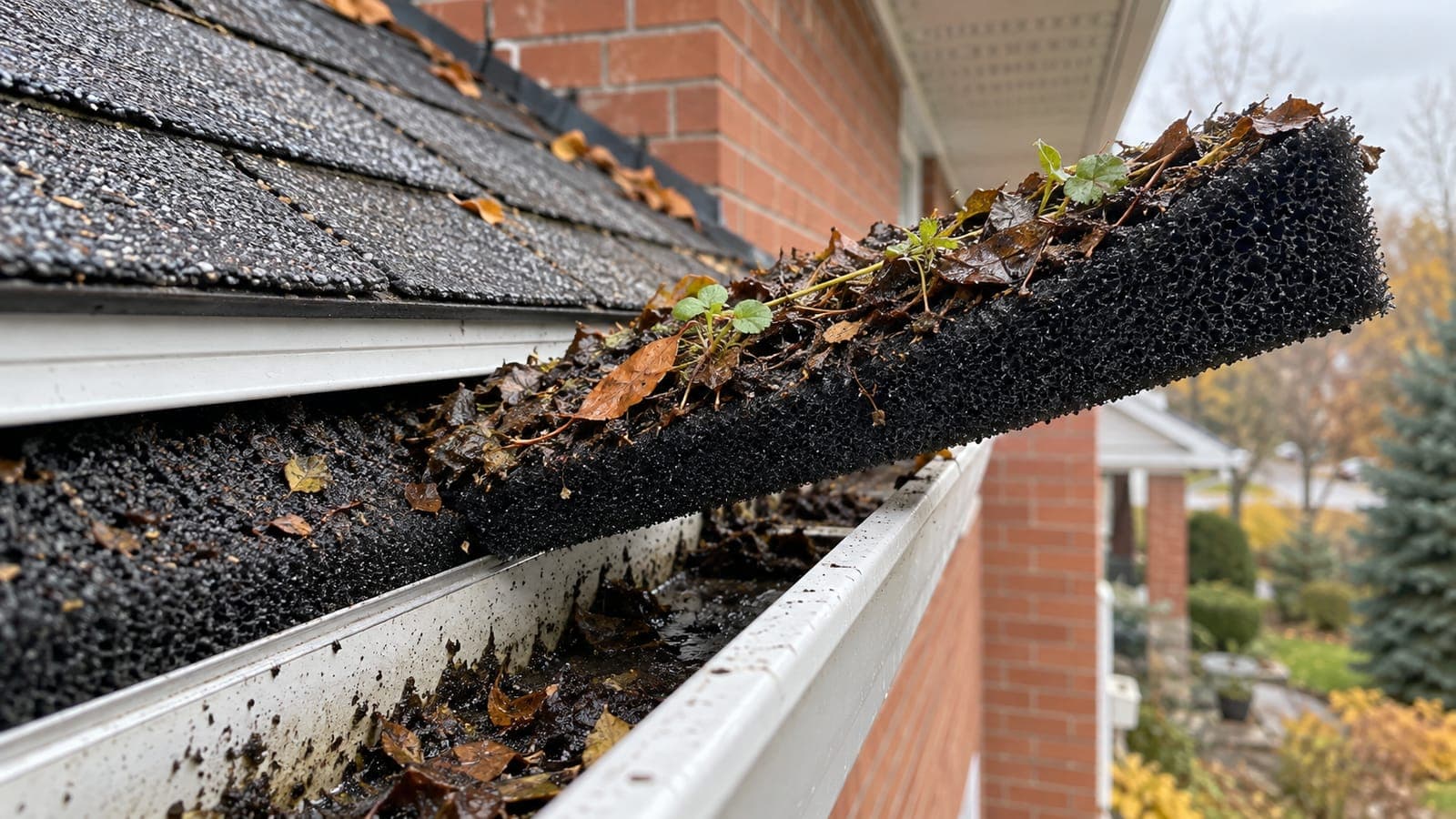
Check each piece before it goes back. Foam that crumbles, has flattened or has seedlings rooted in it is finished, and This Old House says worn or flattened bristles mean a new brush. Both wear out fast in Ontario freeze-thaw, so price fine micro-mesh before buying inserts again; are gutter guards worth it compares the types.
Can you clean gutter guards from the ground?
Partly, on a one-storey roofline. A soft brush on a telescoping pole can sweep dry leaves off mesh and screen tops, and a leaf blower gutter attachment can push loose leaves off. Neither can lift a screen, pull an insert, reach the sediment underneath or prove the downspout drains, and on a second storey you are sweeping blind.
Look up first. The Electrical Safety Authority says to keep yourself and any high-reach tools at least 3 metres (10 feet) from overhead power lines, including the service wire to the house. Cleaning gutters yourself covers the full ladder method.
When should you call a crew instead?
- The guards are above the first storey, or reachable only from the roof.
- Rain still sheets over a brushed guard, or spills at the outlet end of a run.
- Sections have lifted or bent after wind, ice or a storm.
- Needles have matted into needle felt on the mesh, or the run sags under the guard.
- It is November and the screens tuck under cold shingles.
A crew clean on a guarded home lifts the guards, hand-clears and flushes the trough and every downspout, reseats each section and photographs what came out from under it. That time is why the standard price goes up when guards have to come off: by $40.
What does guard cleaning look like in Brampton?
Brampton's guards get an early test. Honey locusts in the old core and Bramalea start dropping in early October, each leaf carrying about two dozen leaflets roughly a centimetre wide (KPU plant database). They slip through coarse screens for weeks, so a screened trough can fill from underneath while the top looks tidy. Maples follow in late October, and Heart Lake's conservation-land oak and pine finish last, leaving needles on the mesh into November.
So time the guard clean to your street: late October in the old core and Bramalea, November near Heart Lake. The garage roof is usually the one guard run within single-storey ladder reach; the second-storey runs above it are a different job. And on the builder downspouts of Springdale and Mount Pleasant, which choke at the first elbow, flush every spout even when the guards look spotless.
A guard-equipped clean in Brampton follows the same steps, with photos before and after. In 2026, a two-storey detached home is $399 before HST plus $40 to take the guards off and put them back, and Castlemore estates are $549 at two storeys plus $40. If your inserts are crumbling or your screens let the locust leaflets through, gutter guards in Brampton are fitted after a full clean and quoted on site.
Sources
- This Old House: maintenance for gutter guards
- CCOHS: portable ladders
- Electrical Safety Authority: powerline dangers during fall cleanup
- Asphalt Roofing Manufacturers Association: shingles in cold weather
- Alu-Rex: access panels
- Simpson: pressure washer use and care manual (PDF)
- KPU plant database: honey locust
Frequently asked questions
Do gutter guards need to be cleaned?
Yes. Guards keep out most whole leaves, but grit, seeds and small leaflets still collect on top of or under every type. Plan a check at least once a year, plus one after the fall drop if heavy trees stand over the roof.
Can I pressure wash my gutter guards?
Not from a ladder. Pressure washer manuals warn that the wand's kickback can make you slip or fall, and a hard jet can bend fine mesh and drive grit into the trough. A soft brush and a gentle hose do the job; check the guard maker's care instructions before trying anything stronger.
How do you clean under gutter guards without taking them off?
Mostly, you can't. Run a hose on the guard at the far end of the run and watch the downspout: a strong, steady stream means the trough drains. Some systems have access panels above the downspouts. If the spout only trickles, lift the section above that outlet and clear it.
Do foam gutter inserts need replacing?
Yes, usually within a few seasons. Foam traps silt, holds water, roots seeds and breaks down through Ontario's freeze-thaw cycles. Replace any length that crumbles, has flattened or has seedlings growing in it, and compare fine micro-mesh before buying foam again.
Keep reading
- Gutter guards in the GTA: worth it or not?
- Pine needles and gutters: why conifer lots are different
- Gutter guard contracts in Ontario: your cooling-off rights
- Gutter guard installation: what is included and how it works
- Gutter guards & eavestrough covers in Brampton: local prices and booking
- Everything we do in Brampton: neighbourhoods, trees and services