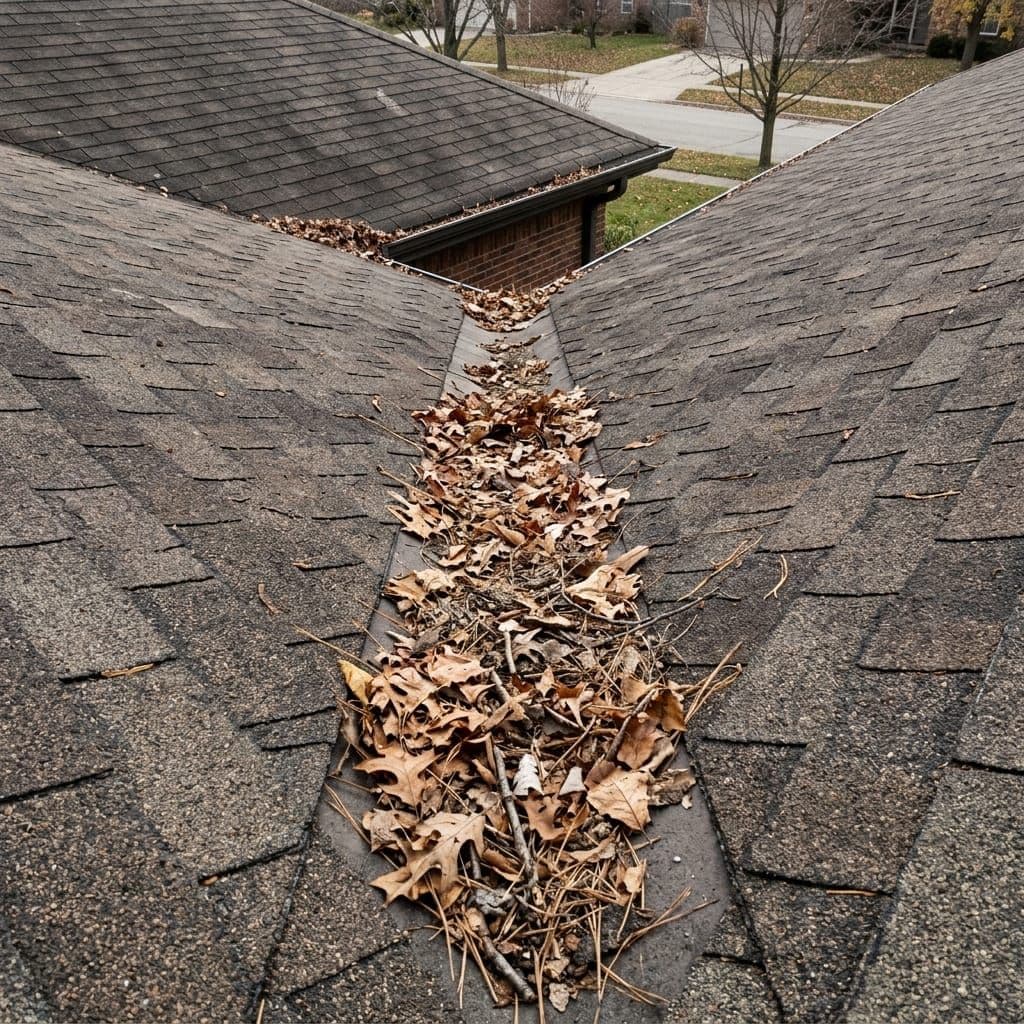
Ravine and valley lots fill gutters far faster than street lots, because a forest delivers debris all season from every direction — not one canopy dropping on one schedule. The rear runs take the worst of it, and they are exactly the runs nobody sees.
Why is a ravine different from a big street tree?
A street maple is one species on one schedule: you clean after its drop and you are done. A ravine is an ecosystem — oak, maple, ash, willow, and conifers shedding in sequence from spring catkins through November leaves, with wind off the valley re-delivering all of it year-round. There is no single 'after the drop' date, because the drop never fully ends. The GTA's ravine systems — the Rouge, the Humber, the Don, the moraine valleys — all bill their neighbours the same way.
The rear-run problem
Valley debris lands overwhelmingly on the roof planes facing the valley — the back of the house, where nobody stands in the driveway looking up. We routinely find front gutters presentable and rear runs packed solid on the same home. That asymmetry is why the before-and-after photos matter most on ravine lots: they are often the owner's first look at the side of their house the forest actually uses.
What the pattern looks like across the GTA
- King City and Kleinburg: moraine and Humber forest standing on the lot itself — debris from every direction, all season
- Guildwood and West Hill: Rouge and Bluffs-edge lots where wind compounds the ravine load
- Bayview Village, Don Mills, York Mills: Don-system ravines feeding oak and ash into rear valleys
- Cornell and Berczy: Rouge woodlots loading the rear planes of newer builds whose owners assume young street trees mean light duty
The maintenance rhythm that actually works
Twice a year is the floor, not the target: spring after the seed drop, late fall after the leaves — and heavy valley years earn a mid-fall touch-up, which is why the heavily-treed modifier exists ($20 in 2026, for the extra hauling). The included downspout flush is non-negotiable on these lots, because valley debris feeds elbows continuously. Fine-mesh guards on the valley-facing runs cut the frequency meaningfully; anything coarser gets threaded by the mixed debris.
Ravine lots also bring more wildlife to the roofline (animals in gutters), and the GTA tree debris guide shows which species drop when. Gutter cleaning in King City is sized for estate lots with forest on every side.
If your back fence is a forest, your rear gutters are working harder than anything else on the house. Get the price, book the rhythm, and let the photos show you what the valley has been sending over the back roofline.
Frequently asked questions
How often should gutters be cleaned on a ravine lot?
At least twice a year, in late spring and late fall, plus an early-October touch-up in heavy years. The downspout flush matters on every visit, because mixed valley debris keeps feeding the elbows.
Why are my back gutters dirtier than the front?
Debris from a ravine or woodlot lands mostly on the roof planes facing it, which are usually at the back of the house. The rear runs can be packed while the front ones look fine from the driveway.
Are gutter guards worth it on a ravine lot?
On the valley-facing runs, fine-mesh guards usually are, because they stop the mix of leaves, needles and seeds. Coarser guards get threaded by that mix and end up needing as much work as bare gutters.
Keep reading
- Maple keys, catkins, acorns: a GTA gutter debris field guide
- Raccoons, squirrels and birds in your eavestroughs
- Gutter guards in the GTA: worth it or not?
- Gutter & eavestrough cleaning: what is included and how it works
- Gutter & eavestrough cleaning in King City: local prices and booking
- Everything we do in King City: neighbourhoods, trees and services