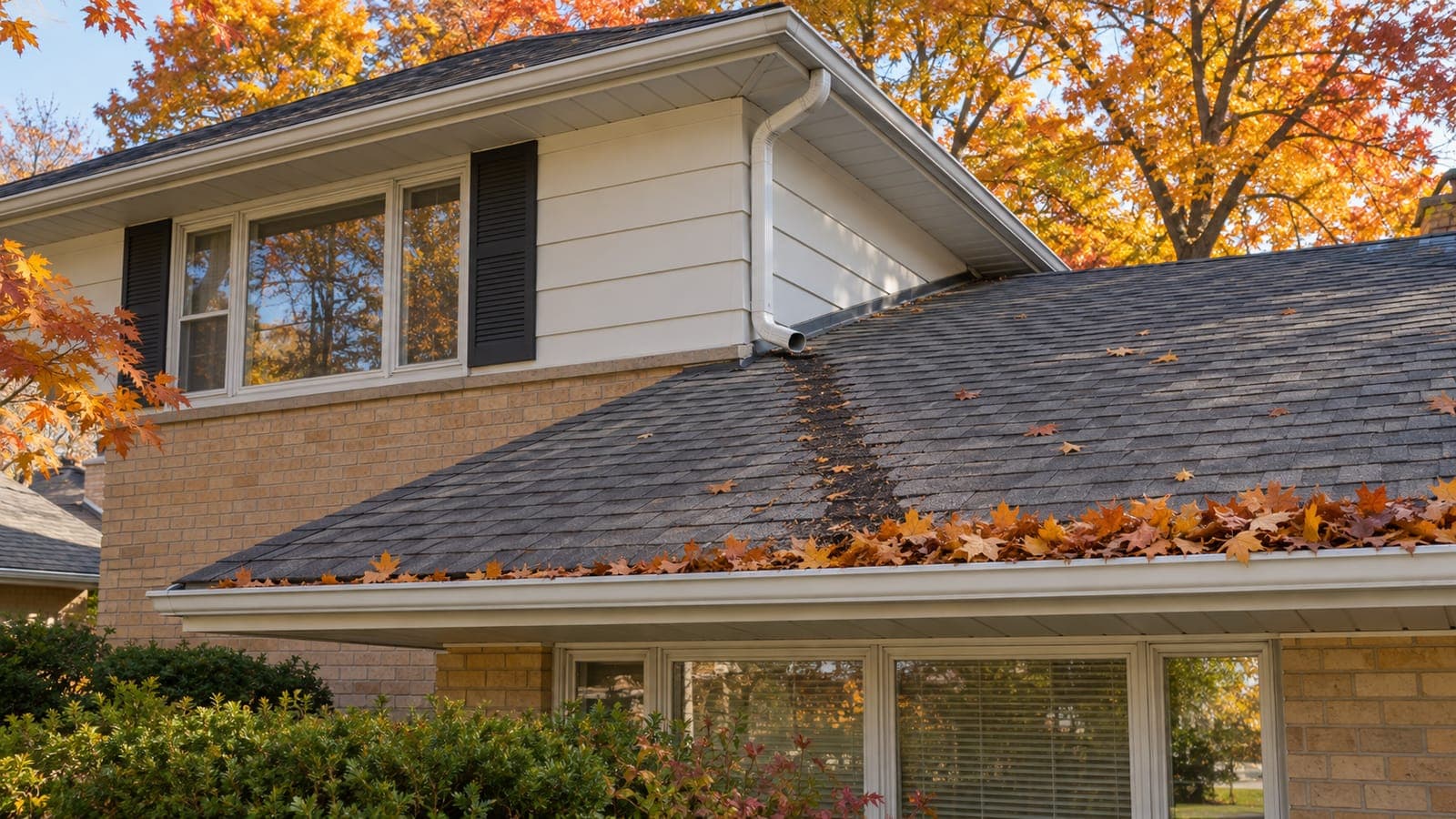
Not if you can avoid it. The asphalt roofing industry's guidance is never to let a downspout discharge directly onto a roof below: the concentrated stream wears granules off the shingles, stains the roof and can let water work underneath. The usual fix is to carry the upper downspout down the lower roof into the lower gutter.
Why do upper downspouts end on lower roofs?
Because it is the shortest route. When an upper eave sits right above a lower roof, a downspout dropped straight down meets shingles long before it meets the ground. Stopping it there, as shingle maker Malarkey's technical bulletin puts it, "may lower costs up front."
- Side-splits and back-splits, where the bedroom level's roof drains onto the roof over the main floor.
- Two-storeys with a garage, porch or sunroom roof under the upper eave.
- Dormers whose short gutter ends open above the main roof.
- Additions guttered without carrying their water past the old roof.
Shingles are built to shed rain as a thin sheet. A downspout turns a whole roof's sheet into one stream, and aimed at another roof, it hits the same narrow strip of shingles every storm.
What does a downspout do to the roof below?
Malarkey Roofing Products recommends against draining one roof onto another, "especially because the lower roof often has less slope than the upper." Its bulletin lists the damage below, and the Home Reference Book, an inspection manual posted by the Canadian Association of Home & Property Inspectors, says the lower roof in the water's path "will deteriorate quickly."
| What happens | What you see | Why it matters |
|---|---|---|
| Granule loss | A bare or darker strip below the outlet | Granules shield the asphalt from sun and weather |
| Staining | A darkened roof marked with drainage channels | Upper-roof grime joins the lower roof's own |
| Algae and moss | Streaks or growth along the wet path | Moss can work under shingles and slow the water |
| Leaks | Ceiling or wall stains, sometimes far from the outlet | Slowed runoff can work under shingles and travel sideways |
| Wall wear | Damp or stained siding at the roof-to-wall joint | Splash and runoff test the flashing there |
Winter adds ice. On a mild afternoon the upper roof's snow melts and pours onto the lower roof; after dark it can freeze where it runs, building ice on the shingles and at the lower eave, where ice dams begin.
To check without climbing, compare the shingles below the outlet with the rest of the roof from an upstairs window or across the street. A darker or balder strip is granule loss for a roofer to look at; moving the water stops it spreading but won't put granules back.
Does it affect your shingle warranty?
It can. Malarkey's bulletin says its warranty against manufacturing defects stays in effect but does not cover damage to shingles attributable to building design or construction, water backup, or mould, mildew and other vegetation. A downspout aimed at a lower roof is a design choice, so damage under it may well fall outside that coverage. Other makers' terms differ, so read yours.
Is a splash block on the shingles enough?
It is the minimum, not the fix. Malarkey recommends a splash block under downspouts but calls a trough that channels the runoff down to a gutter the optimal solution. The Asphalt Roofing Manufacturers Association's Residential Asphalt Roofing Manual, as the bulletin quotes it, is blunter: "Never allow water from a downspout to discharge directly onto a roof below."
A splash block, or a spreader on the outlet, fans the stream over more shingles. The same water and grime still end up in one stretch of the lower trough, so treat it as a stopgap and check after storms that it hasn't shifted.
How is the downspout carried to the lower gutter?
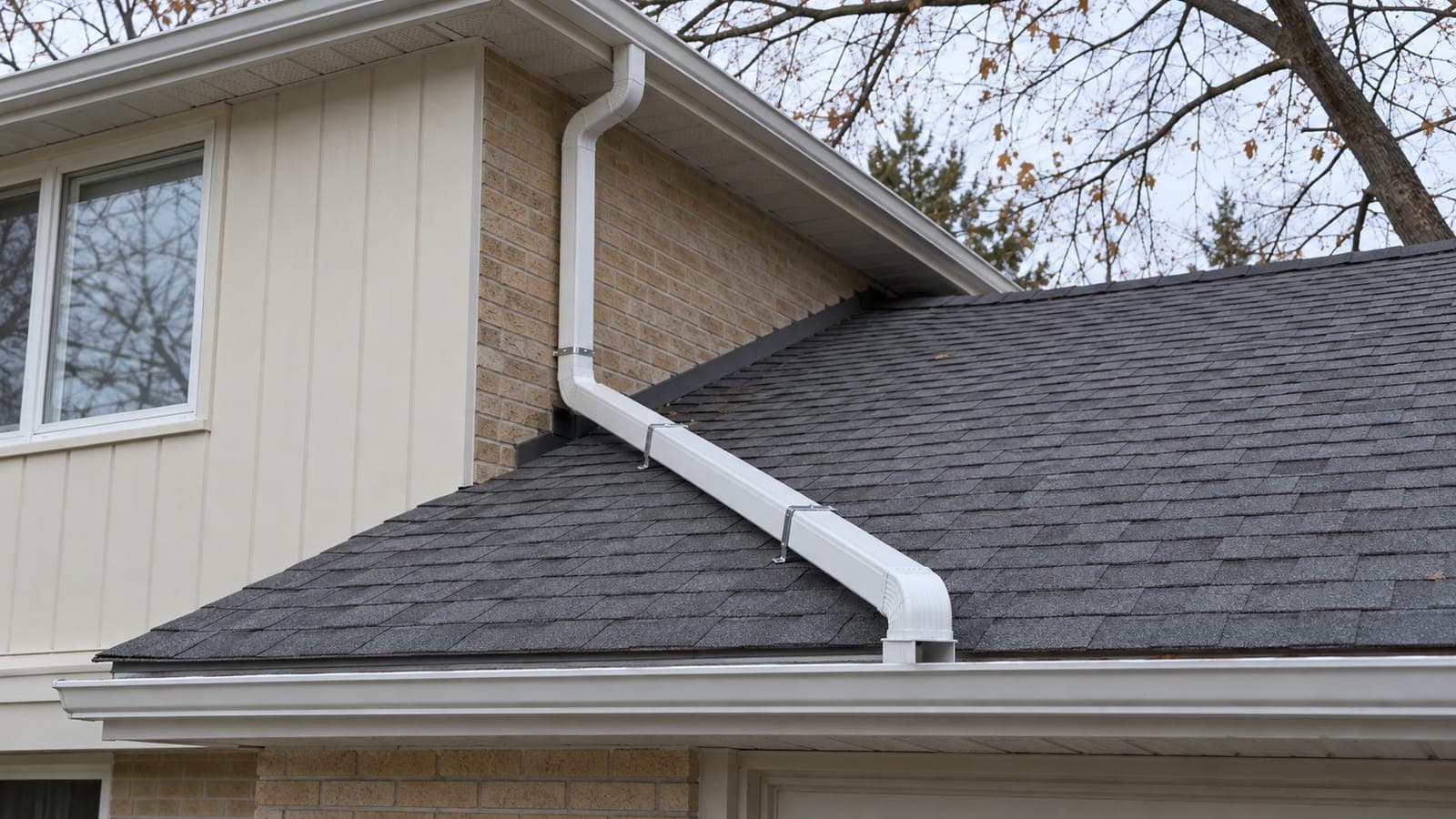
The Home Reference Book's fix is to extend "the downspout along the lower roof to discharge directly into the lower roof gutter." Its drawing shows a dormer gutter piped across the main roof to the gutter below. Malarkey's photos show open troughs and enclosed ones doing the same job.
- 1An elbow at the foot of the upper downspout turns the water down the slope of the lower roof.
- 2A length of downspout, or an open trough, runs down the lower roof to the eave.
- 3A second elbow drops the water into the lower gutter, ideally near that gutter's outlet, so the extra flow has a short trip.
- 4The run is secured against wind, snow and ice. Ask how any fastener through the shingles will be sealed: each one is a new hole in the roof.
- 5A flow test proves it: water poured into the upper gutter should leave the lower downspout without leaking at a joint or spilling where it enters.
Check that the lower trough can take a second roof. If it already spills in a downpour, clear it and check its slope first; if it still overflows, it may need a bigger downspout or a second outlet (sizing explained).
Why does the lower gutter need more attention?
Because it carries two roofs. The upper roof's water arrives with its leaves, maple keys and the granules the stream scours loose, which settle like wet sand and pack the elbow. On a split-level, the lower trough's downspout is usually the first on the house to clog.
- Flush and flow-test the lower downspout every cleaning, even when the upper ones run clear (unclogging a downspout).
- Clear the lower roof too, or the leaves on it wash in with the next rain (roof debris).
- If one run deserves a gutter guard, it is the lower one.
What does this look like in Thornhill?
Thornhill is split-level country. The 1960s and 1970s side-splits and back-splits of Royal Orchard, Thornlea and German Mills have two or three eave heights, and on most of them the upper roof drains onto the lower one. Maple keys collect on those lower roofs in May and June, and the fall drop runs from mid-October into mid-November, with the oaks along the East Don finishing last.
The September 2 storm showed the load. Environment Canada's preliminary count put Thornhill at 93.2 mm of rain. Where an upper downspout ends on the lower roof, the upper roof's share of that rain crossed one strip of lower shingles. If your lower trough spilled that day, start with its downspout and the spot where the stream lands.
Every cleaning includes downspout service in Thornhill: each downspout on each level flushed and flow-tested, and every level in the photo report. Split-levels price by their tallest working height, so most are two storeys: $399 for a detached home before HST in 2026, often $549 for Bayview Glen's larger homes, plus $20 on a heavily treed or ravine lot. A roof blow-off clears the lower roof for $59. A leaking joint is a minor repair from $89, priced on site; new downspout supply and install is quoted separately. See your exact price in the quote flow.
Sources
- Malarkey Roofing Products: when one roof drains onto another (technical bulletin, PDF)
- The Home Reference Book, Exterior, page 39 (CAHPI, PDF)
- CP24: September 2 storm rainfall totals (September 3, 2026)
Frequently asked questions
Can a downspout drain onto a shingle roof?
It can, but roofing manufacturers advise against it. Their trade association, ARMA, says never to let a downspout discharge directly onto a roof below and to connect the upper downspout to the lower gutter. Until then, a splash block under the outlet is the bare minimum.
Should I screw a downspout extension to my shingles?
Not yourself. Every fastener through a shingle is a new hole in the roof, right where the most water runs, and the job means working on the roof. Have an eavestrough installer or a roofer route it and seal any fastener.
Will a downspout on a lower roof void my shingle warranty?
Not necessarily the whole warranty, but the damage may not be covered. Malarkey, for one, keeps its manufacturing-defect warranty in effect but excludes damage attributable to building design or construction, water backup, or mould. Check your own shingle maker's terms.
Why does my lower gutter overflow before the upper one?
Because it is often carrying two roofs: its own rain plus everything the upper downspout drops onto the lower roof, leaves and grit included. Flush its downspout first, then check whether the extra water enters far from the lower outlet, and rule out the other overflow causes.
Keep reading
- Shingle granules in your gutters: normal or a warning?
- Why your gutters overflow even when they're clean
- Flat roof scuppers and drains: clear them before winter
- Downspout services: what is included and how it works
- Downspout cleaning & unclogging in Thornhill: local prices and booking
- Everything we do in Thornhill: neighbourhoods, trees and services