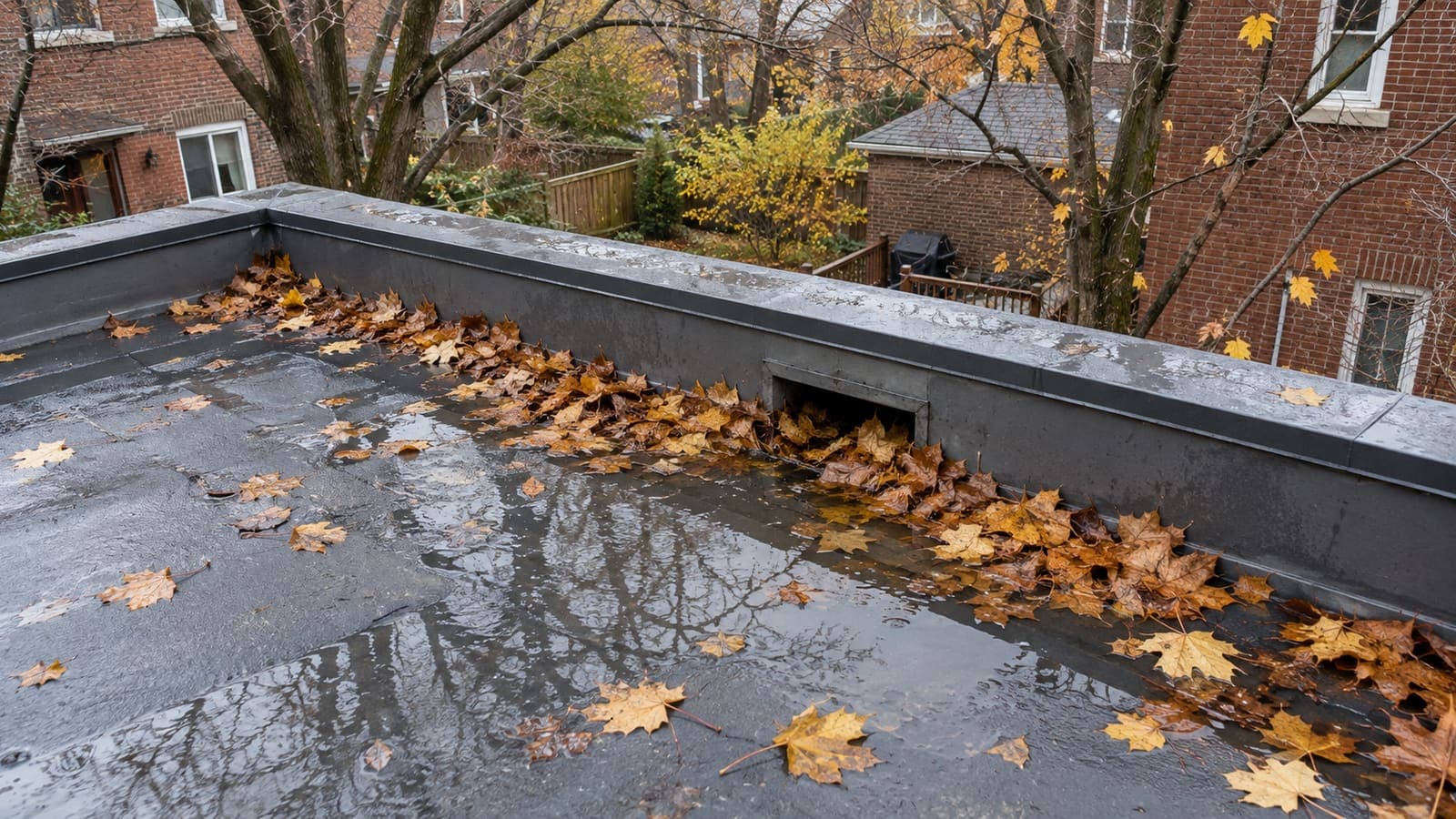
A flat roof drains through a few small openings: scuppers through the parapet, roof drains in the surface, or a short gutter along one edge. Leaves drift straight to those openings and block them, so water ponds and then freezes. Clear them once the leaves are down, usually late October to mid-November in Toronto, and before the first hard freeze.
How does a flat roof drain?
No roof is truly flat. A "flat" roof is built with a slight slope toward its outlets, and those outlets are the whole drainage system. Most GTA homes with a flat section use one or more of these:
| Outlet | What it is | Where the water goes |
|---|---|---|
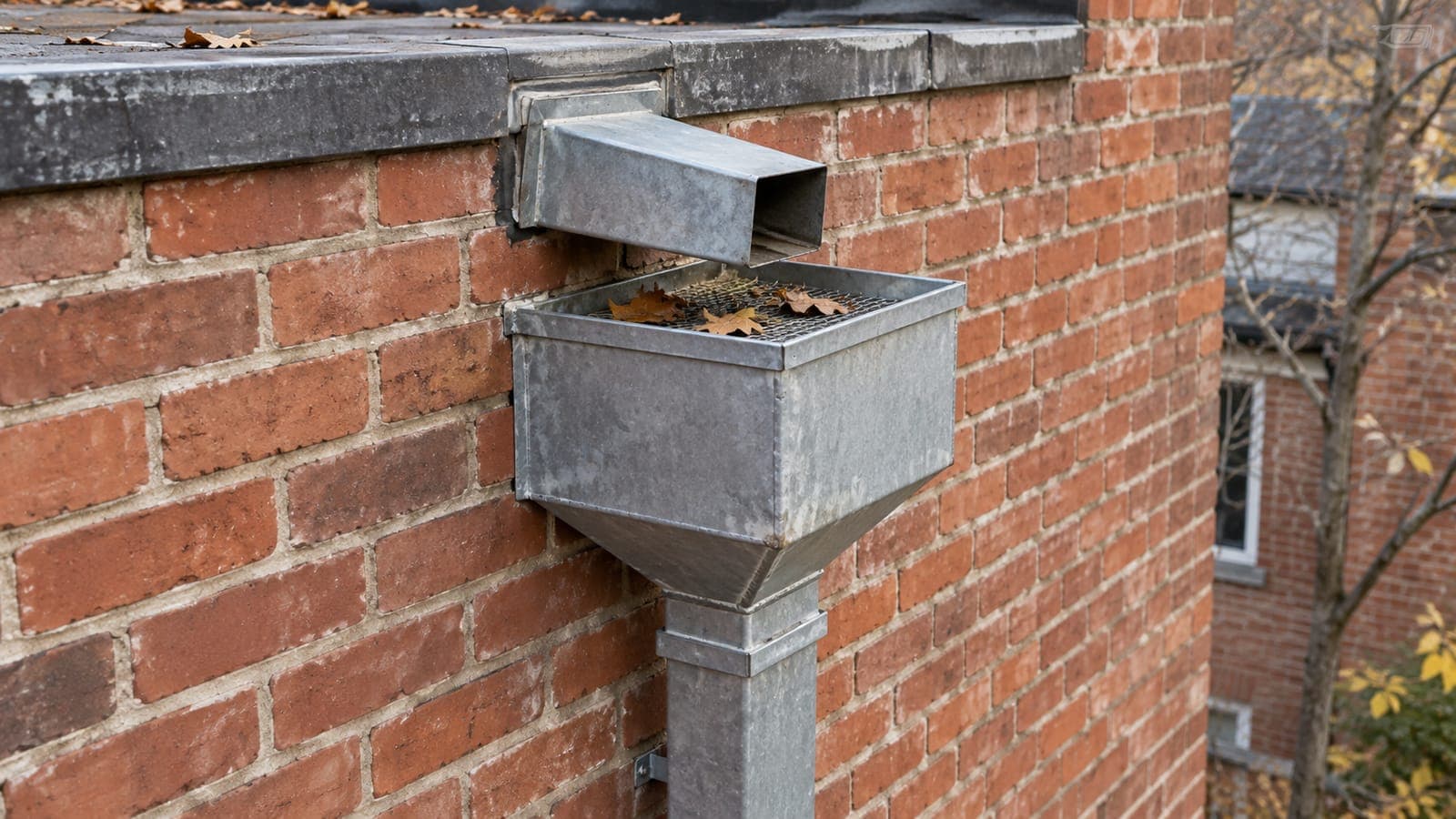
| Scupper | An opening through the parapet wall at roof level | Usually into a conductor head and a downspout on the outside wall |
| Conductor head | A box on the wall that catches scupper water | Into the downspout below it |
| Roof drain | A drain set into the roof surface, with a strainer on top | Through a pipe inside the building to the plumbing or out to grade |
| Edge gutter | An ordinary eavestrough along a low edge with no parapet | Into a downspout, like any gutter |
| Overflow scupper | A second, higher opening for when the main outlet blocks | Spills over the wall; water there means the main outlet is clogged |
On Toronto homes these roofs are everywhere once you look from the back: rear additions on Victorian and Edwardian semis, modern infill with flat roofs, laneway garages and garden suites, porch and bay roofs, and dormers that dump onto a flat deck below.
Why do leaves cause more trouble on a flat roof?
On a pitched roof, rain and wind move most leaves into the gutter, where they can be cleared. On a flat roof they stay put. Wind drifts them against the parapet, and rain floats them to the lowest point, which is exactly where the outlet sits. A single wet mat over a scupper or a roof-drain strainer is enough to stop the flow.
Then the water has nowhere to go. It ponds, soaks the leaf pile into a heavy sludge, and sits against seams and flashings that were built to shed water, not hold it. The Asphalt Roofing Manufacturers Association describes ponding as water that remains on a roof 48 hours or more after rain. In late fall the clock runs out faster, because the pond freezes overnight, expands into every gap and blocks the outlet with ice as well as leaves.
When should you clear a flat roof in Toronto?
After most of the leaves are down and before the first hard freeze. Downtown, Environment and Climate Change Canada's 1991 to 2020 normals for the Toronto city station put the average first fall frost on November 6, with about eight nights at or below zero in November and twenty in December. At Pearson, the first frost averages October 20. On most streets that makes late October to mid-November the window, the same one as the main gutter cleaning.
Under big oaks, which hold their leaves into late November, a second look before the freeze is worth it. A roof outlet blocked in December stays blocked until the next thaw.
How can you check a flat roof drain safely?
Most of the checking can be done without setting foot on the roof:
- 1Look from an upstairs window during or right after a rain. Water should move toward the outlets, not sit in a growing puddle.
- 2Check the next morning. Standing water a day after rain is a warning; at 48 hours it is ponding.
- 3Go outside in the rain and watch the downspout below each scupper or conductor head. A dry spout during a downpour means a blockage above it.
- 4Look for water pouring over the parapet or out of an overflow scupper. Both mean the main outlet is not keeping up.
- 5Inside, check the ceiling under the flat roof and around any interior drain pipe for fresh stains.
What do a scupper and conductor head need?
A clear opening and a clear path below it. Pull loose leaves away from the scupper and out of the conductor head, and make sure any screen on the head is not matted over. Then flush the downspout below, because a scupper only works if the pipe it feeds is open. A packed elbow at the bottom backs water up into the conductor head, and from there over the parapet.
A roof drain in the surface needs its strainer, the dome or grate over the opening, kept free of leaves. Lift debris off the strainer rather than removing it, because the strainer is what keeps leaves out of the pipe inside the house. Where a flat roof drains to an ordinary eavestrough, treat it like any gutter, and see where downspouts should drain for the ground end.
When is it roofer work, not a cleaning?
Clearing loose leaves from the surface, the outlets and the gutters and downspouts they feed is a cleaning job. Call a roofer if you see water still ponded two days after rain with the outlets clear, blisters, splits or soft spots in the membrane, gaps where the membrane meets the parapet, or a stain on the ceiling below. A roof drain that stays slow once its strainer is clear has a blockage in the pipe inside the house, and that is a plumber's job.
The rules back the homeowner up here, too: Toronto's property standards bylaw, Chapter 629, requires roofs to be kept weather-tight and free of dangerous accumulations of ice and snow. Are eavestroughs required? covers what the bylaws say about gutters and downpipes.
What does this look like in Toronto?
Toronto's flat roofs sit under its biggest trees. The Norway and silver maples over Roncesvalles, High Park, The Beaches and Leslieville drop from mid-October to mid-November, and on narrow semi lots the rear addition is often the lowest roof on the block, right under the canopy. Upper downspouts sometimes empty onto those same additions, which doubles the load; downspouts draining onto a lower roof covers that setup.
The roof debris service in Toronto is a $59 add-on to a cleaning: loose leaves and grit blown off reachable roof surfaces and valleys where it is safe to work, and whatever washed into the gutters and downspouts pulled out, with before and after photos. A cleaning on a typical two-storey semi runs $369, and $459 at three storeys, before HST in 2026. Membrane repairs, interior drain lines and parapet work go to a roofer or plumber, and if the photos show a problem, you will see it.
Sources
- Environment and Climate Change Canada: Toronto (city) climate normals, 1991 to 2020
- Environment and Climate Change Canada: Toronto Pearson climate normals, 1991 to 2020
- Asphalt Roofing Manufacturers Association: Ponding water basics
- Toronto Municipal Code Chapter 629, Property Standards (PDF)
Frequently asked questions
What is a scupper on a flat roof?
A scupper is an opening through the parapet wall at roof level that lets water drain off the edge. It usually empties into a conductor head and a downspout on the outside wall.
How long should water sit on a flat roof after rain?
Not long. Roofing-industry definitions treat water still standing 48 hours after rain as ponding. If the outlets are clear and water still sits that long, have a roofer check the slope and membrane.
Can leaves damage a flat roof?
Yes. Leaves drift to the outlets and block them, so water ponds against seams and flashings, and in winter the pond freezes. Wet leaf piles also hold moisture against the membrane for weeks.
Who clears a clogged interior roof drain?
Loose leaves on the strainer can be lifted off during a roof clean-up. If the drain stays slow once the strainer is clear, the blockage is in the pipe inside the house, which is plumber work.
Keep reading
- Built-in box gutters on older Toronto homes: a guide
- Should you blow the leaves off your roof?
- Downspout draining onto a lower roof: is it OK?
- Roof debris removal: what is included and how it works
- Roof debris removal in Toronto: local prices and booking
- Everything we do in Toronto: neighbourhoods, trees and services