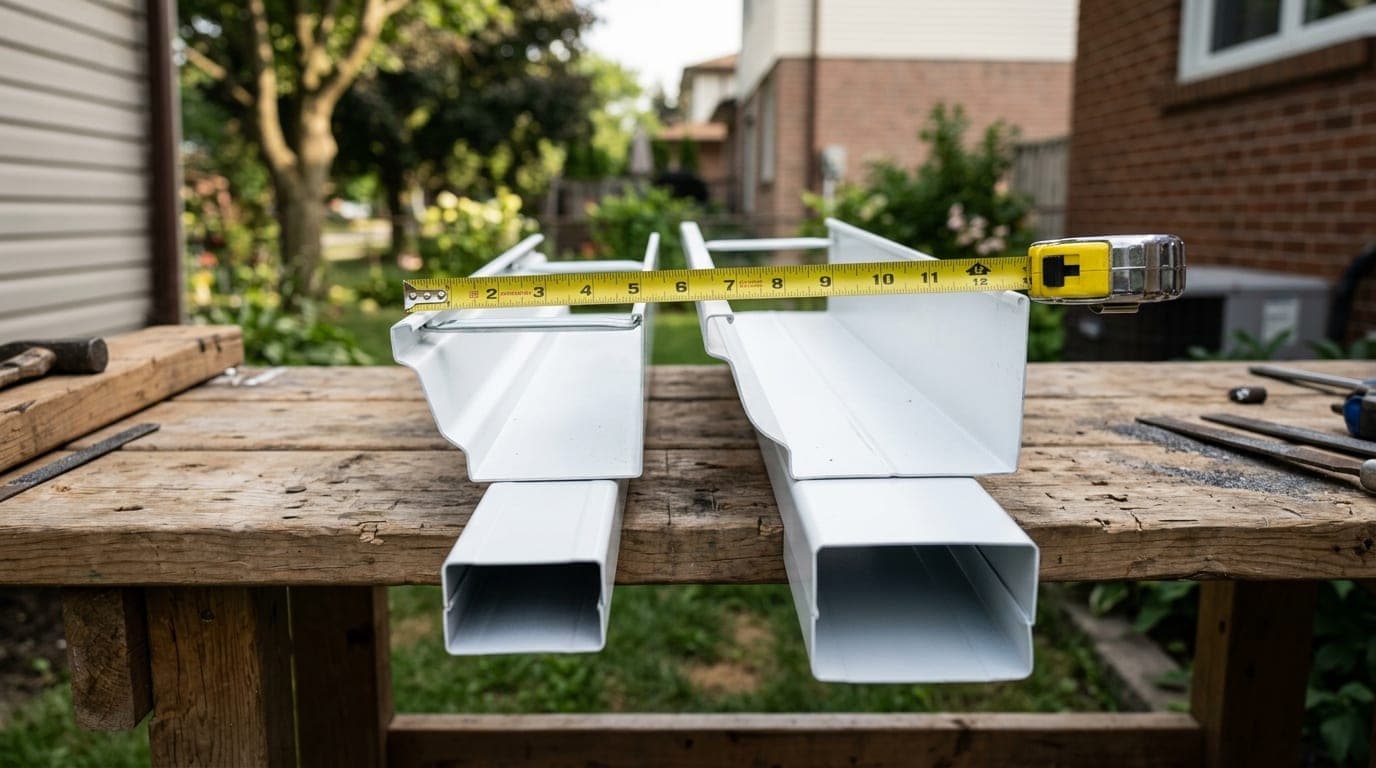
Most GTA homes have 5-inch K-style eavestroughs with 2-by-3-inch downspouts, and that works for typical roofs. Six-inch gutters and 3-by-4 downspouts make sense for large or steep roof planes, valleys that pour into one corner, and heavily treed lots. Often adding a downspout solves overflow more cheaply than upsizing the whole gutter.
What do gutter sizes actually mean?
Eavestrough size is measured across the top opening. A 5-inch K-style gutter is the residential standard across Canada; 6-inch is the common upgrade, holding noticeably more water per metre. Downspouts are measured by their rectangular face: the standard 2-by-3-inch spout has a 6-square-inch opening, and the 3-by-4 upgrade has 12, exactly twice the room for water and debris.
To check yours, measure straight across the top of the gutter from the back edge to the front lip, and measure the face of a downspout. Most houses built or re-guttered in the last few decades will read 5 inches and 2 by 3.
K-style is not the only profile. Half-round gutters, a semicircle in cross-section, suit heritage homes and are common in copper, but at the same width they carry less water than K-style because of their shallower shape. On a typical GTA house the real choice is between 5- and 6-inch K-style, with the downspout size as the second lever.
What decides the right size?
- Roof area per outlet: how many square metres of roof drain to each downspout. A big roof plane with one outlet is the classic undersized setup.
- Roof pitch: a steep roof delivers water faster and further, so it can overshoot a small gutter in a downpour.
- Valleys: two roof planes meeting concentrate their water into one corner.
- Rain intensity: GTA summer thunderstorms test every gutter; the question is how often yours spills in ordinary rain.
- Debris: on heavily treed lots, bigger gutters and spouts simply take longer to choke.
When is a 6-inch gutter worth it?
| Situation | Usually enough | Consider upsizing |
|---|---|---|
| Typical two-storey, moderate pitch, several downspouts | 5-inch gutter, 2-by-3 spouts | Rarely needed |
| Long run with one outlet at the far end | Add a second downspout | 6-inch if it still spills |
| Valley emptying into a corner | Valley splash guard at the corner | 6-inch on that run |
| Steep, large roof planes | 3-by-4 downspouts | 6-inch gutter |
| Heavily treed or ravine lot | 3-by-4 downspouts and regular cleaning | 6-inch with 3-by-4 spouts |
Which cheaper fixes should you try first?
- 1Make sure it is not a clog. A partly blocked elbow looks exactly like an undersized gutter in a storm. Clear and flush it.
- 2Check the slope. A run that pools and overflows mid-span has a pitch problem, not a size problem.
- 3Add a downspout. Two outlets on a long run halve the load on each.
- 4Upsize just the downspout to 3-by-4. On many 5-inch systems the outlet can be enlarged to suit, and it is far cheaper than new gutters.
- 5Fit a valley splash guard where water jumps the corner. Overflow causes covers these in detail.
Does gutter size change cleaning?
A little. Bigger gutters take longer to fill with debris before they overflow, which buys time between cleanings, but they still need clearing on the GTA's two-peak calendar. The bigger win is the downspout: 3-by-4 spouts let maple keys and leaf fragments through that would wedge in a 2-by-3 elbow. On heavily treed lots that change alone can end the annual clogged-spout routine.
What about Brampton's big rooflines?
Brampton is mostly two-storey detached homes with generous footprints, long gutter runs and double-car garage rooflines, often with one downspout at the far corner of a long garage roof. Builder downspouts in the newer areas clog fast when the trees shed, and in the older core and Bramalea mature maples and honey locusts add heavy loads. Adding outlets and upsizing downspouts often fixes chronic overflow there without new gutters.
We don't install new eavestroughs, but every cleaning in Brampton ends with each downspout flushed and flow-tested, which shows whether the size or the spout is the real problem. In 2026, a two-storey detached home runs $399 before HST, and minor repairs in Brampton are priced on site and approved before work begins.
Frequently asked questions
What size are standard gutters in Canada?
Most houses have 5-inch K-style aluminum eavestroughs with 2-by-3-inch downspouts. Six-inch gutters and 3-by-4 downspouts are the common upgrade for large, steep or heavily treed roofs.
Can I put a bigger downspout on a 5-inch gutter?
In many cases, yes. A 3-by-4 downspout can often be fitted to a 5-inch gutter with a matching outlet, doubling the drain opening without replacing the gutter itself.
How many downspouts does a gutter need?
A common rule of thumb is one downspout for every 10 to 12 metres of gutter, and more where large roof planes or valleys concentrate water. Long runs are usually split to drain both ways to two outlets.
Will 6-inch gutters stop overflow?
If the gutter is genuinely undersized for the roof, yes. If the overflow comes from a clog, lost slope or a valley at one corner, a bigger gutter just overflows later; fix the cause first.
Keep reading
- Seamless vs sectional eavestroughs: what's the difference?
- Why your gutters overflow even when they're clean
- How to unclog a downspout (above ground and underground)
- Gutter repair: what is included and how it works
- Eavestrough & gutter repair in Brampton: local prices and booking
- Everything we do in Brampton: neighbourhoods, trees and services