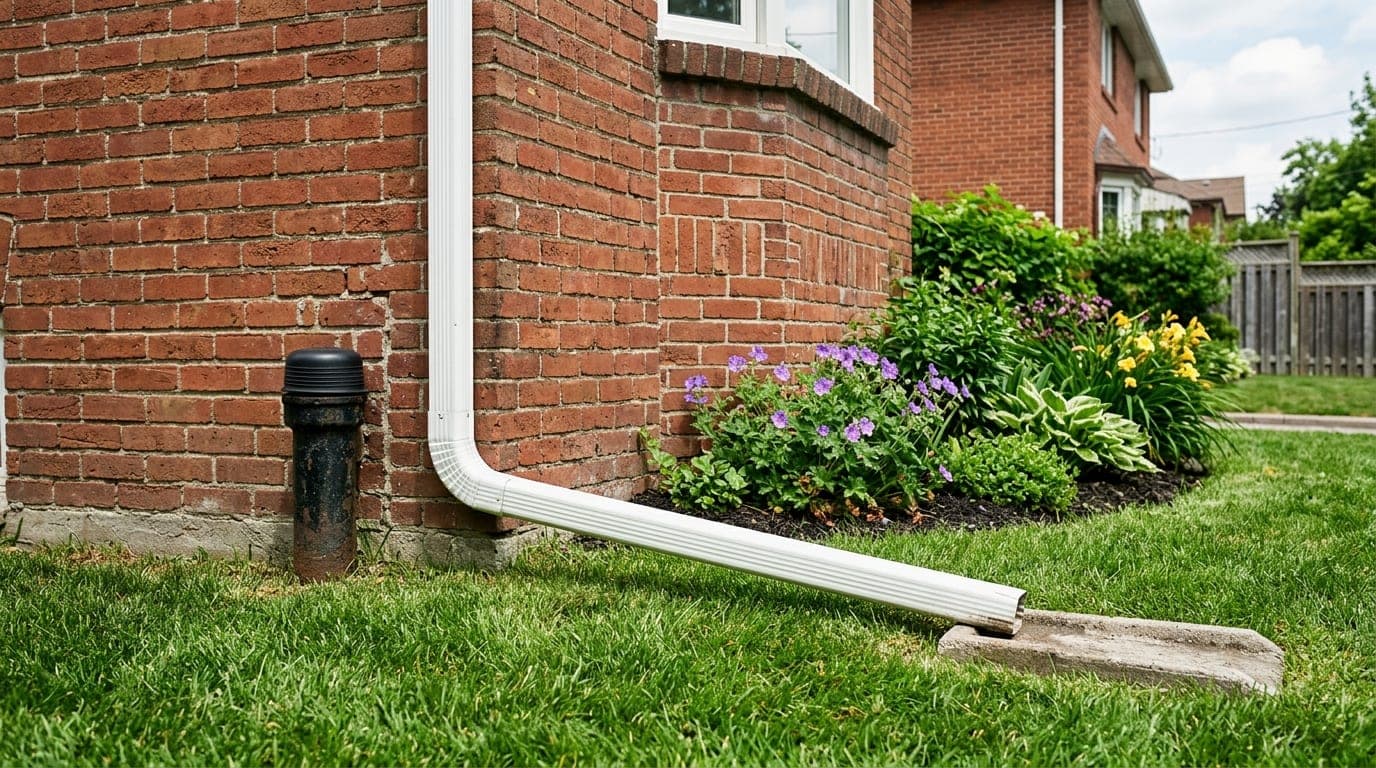
Yes. In Toronto, downspouts must be disconnected from the City's sewer system unless the City has granted an exemption. The rule is in the Sewers bylaw (Municipal Code Chapter 681). The disconnected water has to stay on your own property: away from your foundation, off your neighbour's land and not onto a City sidewalk.
What does the bylaw actually require?
The City's wording is blunt: it is mandatory for all property owners in Toronto to ensure their downspouts are disconnected from the City's sewer system. That covers houses, but also commercial, industrial and institutional buildings. A downspout that runs into a pipe in the ground and connects to a City sewer needs to be cut, capped and redirected, unless the City has formally exempted it.
The reasoning is capacity. In a heavy storm, roof water piped straight into the sewers adds to the flow that can back up into basements. A disconnected downspout lets that water soak into the lot instead.
Where is disconnected water allowed to go?
The City's guidance, backed by the Property Standards bylaw (Municipal Code Chapter 629), sets four conditions for where your downspout discharges:
- Water flows away from your foundation walls
- Water does not negatively affect your neighbour's property
- Water does not flow directly onto a City sidewalk
- The discharge does not create a tripping hazard or dangerous icy conditions in winter
Within those rules you have options. The City suggests a splash pad to stop erosion at the outlet, and alternatives such as a rain garden, a rain barrel or an extension that runs under a deck. Whatever you choose, the extension should carry water 1.5 to 2 metres out onto ground that slopes away, as in where downspouts should drain.
How is a downspout disconnected?
- 1Cut the downspout a short distance above the standpipe (the pipe that disappears into the ground).
- 2Cap the standpipe securely. The City's instruction is to prevent water from going in and to stop animals falling into the opening.
- 3Fit an elbow to the cut end of the downspout, then an extension long enough to reach ground that slopes away from the house.
- 4Put a splash pad at the outlet so the stream spreads instead of carving a trench.
- 5Check it in the next real rain: water should move away from the house and stay on your lot.
Who can get an exemption?
The City grants exemptions where disconnection would be hazardous or is not technically feasible, and it decides downspout by downspout. You apply with the City's Mandatory Downspout Disconnection Exemption Application, which includes a sketch of your property, and are told in writing whether each connected downspout is exempt. Before applying, the City expects you to try moving a downspout, re-sloping the eavestrough or fixing the yard grading. Exemptions can be revoked if conditions on the property change significantly, so a renovation that opens up a new discharge route may end one.
Is there financial help?
Yes, for some owners. The City's Mandatory Downspout Disconnection Financial Assistance program reimburses labour and materials, up to $500, for owners of a residential property in Toronto with a combined household income of $50,000 or less who are 65 or older, or who have a disability and receive disability benefits. Some owners under 65 who receive certain pension or federal income-support benefits also qualify; the City's form lists the exact rules. You pay first and apply within one year of finishing the work, with itemized receipts and before and after photos, so take a photo before anything is cut. Details and the form are on the City's disconnection page linked below.
What changes for gutter maintenance once you disconnect?
Everything that used to vanish underground is now visible, which is mostly good news. A clog shows up as overflow, and the extension's aim decides whether water ends up in the lawn or the basement. It also means the whole job rests on the gutters and downspouts flowing freely, especially in fall when leaves arrive fastest.
Our crews don't cut or cap sewer connections; that is work for a plumber or a disconnection contractor. What every visit does include is a downspout flush and a check that water leaves each spout and heads away from the house. Downspout service in Toronto runs on those terms, with before and after photos of your gutters in your inbox.
Sources
- City of Toronto: Mandatory Downspout Disconnection
- City of Toronto: Mandatory Downspout Disconnection Exemption Application (PDF)
- Toronto Municipal Code Chapter 681, Sewers (PDF)
Frequently asked questions
Is downspout disconnection mandatory in Toronto?
Yes. Every property owner in Toronto must make sure their downspouts are disconnected from the City's sewer system, unless the City has granted an exemption for a specific downspout.
Can my downspout drain onto my neighbour's property?
No. Under the City's rules, disconnected downspout water must stay on your property, flow away from your foundation and not negatively affect your neighbour's property or run directly onto a City sidewalk.
What do I do with the old pipe in the ground?
Cap it securely. The City's guidance is to seal the standpipe so rainwater cannot get in and animals cannot fall into the opening.
Does the disconnection rule apply outside Toronto?
This bylaw is Toronto's. Other GTA municipalities set their own rules for downspouts and lot drainage, so check with your city before changing a connection.
Keep reading
- Toronto's basement flooding subsidy: what it covers in 2026
- Where should your downspouts actually drain?
- How to unclog a downspout (above ground and underground)
- Downspout services: what is included and how it works
- Downspout cleaning & unclogging in Toronto: local prices and booking
- Everything we do in Toronto: neighbourhoods, trees and services