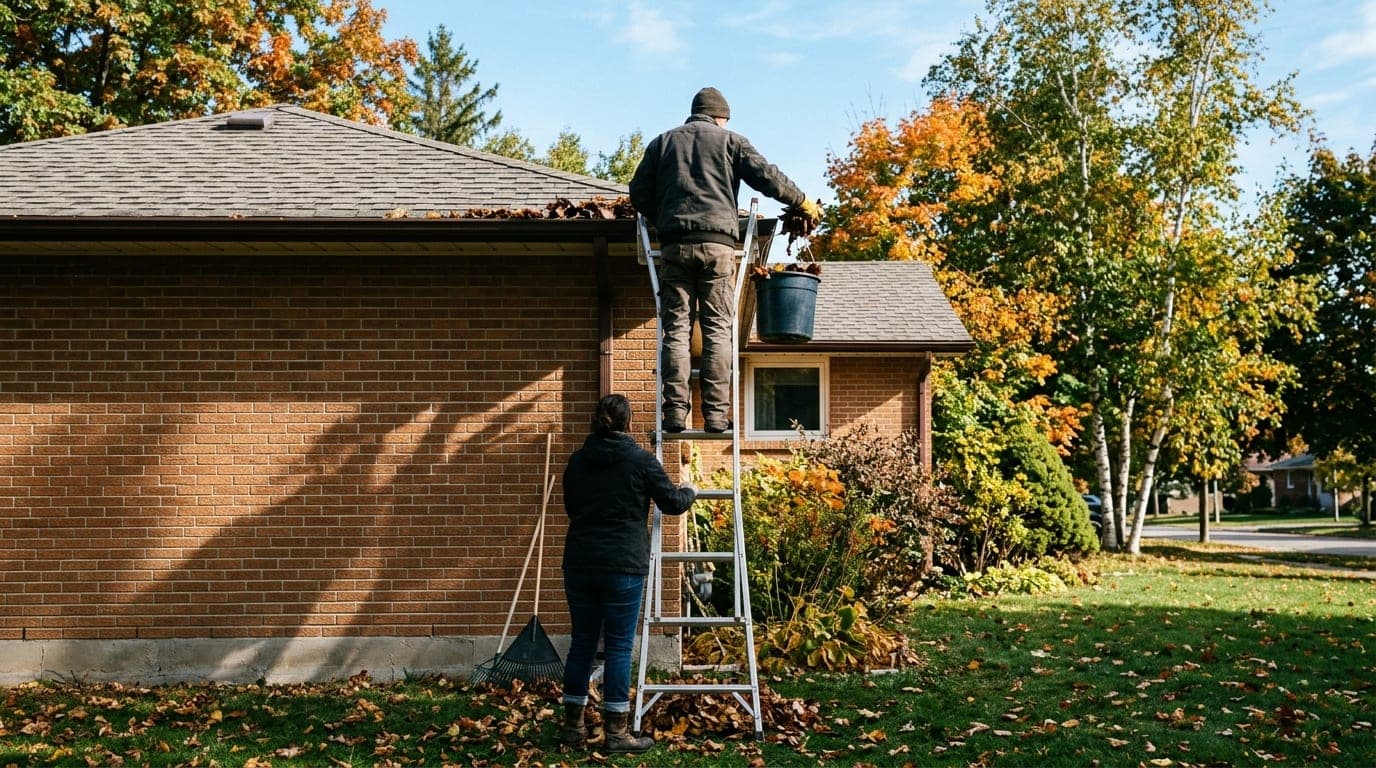
To clean gutters yourself, pick a dry day, set an extension ladder on firm ground at a 4-to-1 angle with a standoff, and scoop debris by hand into a bucket, working toward the downspout. Then flush the trough and each downspout with a hose to prove it drains. Leave second-storey and wet-roof work to a pro.
When is it reasonable to do it yourself?
A one-storey bungalow or a garage, on a dry, calm day, with someone to help, is a reasonable DIY job for most people comfortable on a ladder. Two- and three-storey homes, steep or wet roofs, gutters with guards, and heavy needle felt are where the risk climbs quickly. DIY vs professional does the honest cost and risk math; this guide assumes you have decided to do it.
What do you need?
- An extension ladder rated for your weight plus tools, tall enough to reach without standing on the top rungs
- A ladder standoff (stabilizer), so the ladder rests on the wall, not the gutter
- Work gloves: gutter debris hides sharp screws, metal edges and sometimes glass
- A plastic gutter scoop or narrow trowel, and a bucket with a hook, or a tarp below
- A garden hose with a spray nozzle long enough to reach every run
- Safety glasses, since debris and water fly when you flush
- A helper to steady the ladder and pass things up
How do you set up the ladder safely?
- 1Look up before you stand the ladder: keep yourself, the ladder and your tools at least 3 metres from overhead power lines, including the service line to the house. Carry the ladder horizontally.
- 2Set the feet on firm, level ground; on soft soil, use a board under the feet.
- 3Angle it using the 4-to-1 rule: one foot out from the wall for every four feet up.
- 4Rest the standoff on the wall below the eave so no load goes onto the gutter.
- 5Climb facing the ladder with three points of contact, and keep your belt buckle between the rails. Move the ladder rather than reaching.
- 6Never stand on the top three rungs of an extension ladder.
How do you clean the gutter, step by step?
- 1Start at the downspout outlet and clear the debris around the hole first, lifting it out so later scooping doesn't pack it into the spout.
- 2Work away from the outlet in arm's-length sections, scooping into the bucket. Move the ladder every metre or so.
- 3Check hangers and joints as you go: note loose spikes, leaking seams and sags for later.
- 4Once the run is clear, flush it with the hose from the far end toward the outlet and watch the water travel.
- 5Flush each downspout from the top at full flow. A full-bore stream at the bottom means it is clear; a trickle means a clog. Clearing a downspout.
- 6Check the discharge: the extension should carry water 1.5 to 2 metres away onto ground that slopes away.
- 7Bag the debris; most GTA municipalities accept it with yard waste.
What should you avoid?
- Leaning the ladder on the gutter: it bends the lip and loosens hangers.
- Working on a wet or windy day, when both the ladder and the debris are harder to control.
- Pressure washers in the gutter or down the spout; they split seams and blow elbows apart.
- Walking on the roof to reach the gutter. Work from the ladder, or call someone.
- Blowing wet debris around: it sticks to the siding and the valleys and ends up back in the gutter.
When should you hand it to a crew?
Call someone if the gutters are above the first storey, the roof is steep or wet, the gutters have guards that need lifting, the debris is matted needle felt, or you do not have a helper. Also if the flush fails and the downspout will not clear from the bottom. The same four-part job, done with standoffs and the right ladders, is described in what happens during a professional cleaning.
Why is DIY harder on most Brampton homes?
Brampton is mostly two-storey detached homes with generous footprints, long gutter runs and double-car garage rooflines. The garage gutter may be a reasonable DIY job; the second-storey runs above it generally are not. In the older core and Bramalea, mature maples and honey locusts drop heavy loads, and around Heart Lake conservation land adds oak and pine.
If the second storey is where you draw the line, gutter cleaning in Brampton is $399 before HST for a two-storey detached home in 2026: every run cleared by hand, every downspout flushed, debris hauled away, and before and after photos in your inbox.
Sources
- Canadian Centre for Occupational Health and Safety: Portable ladders
- Electrical Safety Authority: overhead powerline dangers during fall cleanup
Frequently asked questions
What is the easiest way to clean gutters?
From a properly set ladder, scoop debris out by hand into a bucket, then flush each run and downspout with a garden hose. It is slower than blowing, but it removes the debris instead of scattering it and proves the system drains.
Can I clean gutters from the ground?
Telescoping wands and gutter vacuums can move loose, dry leaves from low gutters. They cannot reliably clear wet, packed debris or needle felt, and you cannot see what is left behind or flush the downspouts properly from the ground.
How long does it take to clean the gutters on a bungalow?
For a first-timer, allow a few hours, including setting up, moving the ladder and flushing. A professional crew typically takes one to three hours for most homes, depending on size and storeys.
Is it better to clean gutters when the debris is wet or dry?
Slightly damp debris scoops out most cleanly; bone-dry leaves blow around and soaked mats are heavy. What matters most is the weather for the ladder: pick a dry, calm day with firm ground.
Keep reading
- DIY vs professional gutter cleaning: the honest math
- How to unclog a downspout (above ground and underground)
- What actually happens during a professional gutter cleaning
- Gutter & eavestrough cleaning: what is included and how it works
- Gutter & eavestrough cleaning in Brampton: local prices and booking
- Everything we do in Brampton: neighbourhoods, trees and services