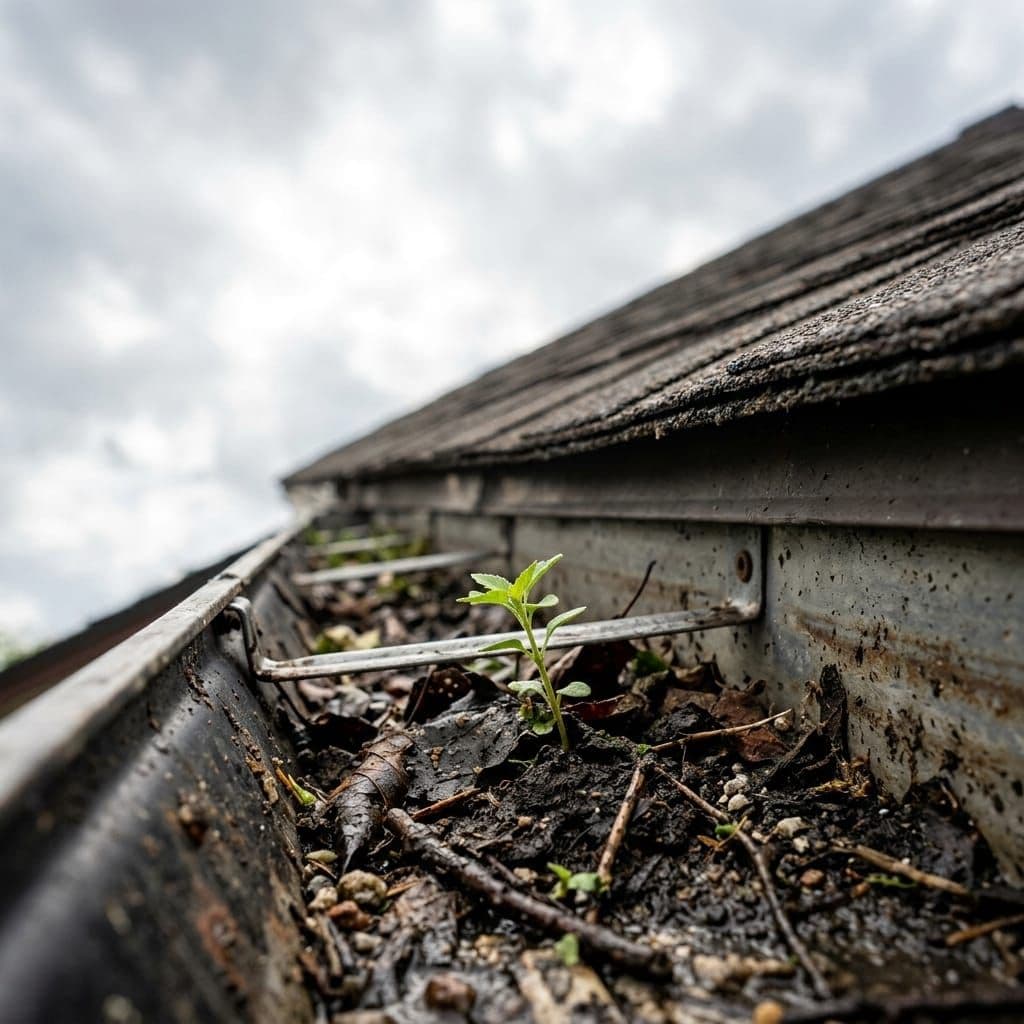
You can diagnose clogged gutters from the ground in five minutes: water sheeting over the edge during rain, silent downspouts in a downpour, plants growing from the trough, stains or streaks on the fascia and siding, and mud splash or trenching in the soil below. Any one of them means the system is failing.
The five signs, in the order to check them
- 1. Water over the edge during rain — especially at corners, where debris packs first
- 2. A silent downspout in a downpour — a working spout is audible; silence means blocked, not dry
- 3. Green residents — grass, seedlings, even small trees rooted in the debris layer
- 4. Stains and streaks — dark vertical lines on siding, algae below a run, watermarks on fascia board
- 5. Ground evidence — mud splash on the wall, a trench line in the soil, eroded mulch under a gutter run
Why is rain the best inspection tool you own?
Because a gutter can look fine and still be blocked at the outlet or in the downspout elbow — the failure only shows when water is moving. Next real rain, take two minutes under an umbrella and walk the house perimeter: every downspout should be pushing water out the bottom, and no edge should be spilling. That circuit tells you more than an hour of squinting on a dry day.
Which sign is the most urgent?
The silent downspout. Overflow at an edge wets your siding; a blocked spout backs up the entire run it drains and aims the overflow at one concentrated spot — usually right beside your foundation. Scarborough's side-splits are a special case: the upper roof often drains onto the lower one, so one blocked lower spout can be carrying both levels' failure without either gutter looking full from the street.
What if you spot a sign — how fast does it matter?
Debris compounds: a partial clog catches more debris, which slows the water further, which catches more. In fall, a gutter can go from slow to solid in a couple of windy weeks — the silver-maple streets of Wexford and Agincourt prove it every October. Caught at sign one or two, it is a routine cleaning at 2026's $299–$499. Ignored through a winter, it graduates into fascia rot, ice dams, and the foundation story nobody enjoys.
If the gutter is clean but still spills, the overflow causes are slope, size, a valley or a half-blocked spout; downspout service in Scarborough clears and flow-tests every spout on the house.
Run the five-minute check this week. If anything on the list shows up, every cleaning we do includes the downspout flush and flow test — and the before-and-after photos mean you will see exactly what the problem was.
Frequently asked questions
How often should I check my gutters?
Do the rain check every spring and fall, and again after any big windstorm. It takes a couple of minutes walking the house during steady rain and catches most problems before they cause damage.
Can clogged gutters cause roof leaks?
Indirectly, yes. Clogged, frozen gutters help ice dams form, and a full gutter can spill backward behind itself onto the fascia. Water running behind gutters explains that path.
Why is there standing water in my gutter after it rains?
Either a clog is damming it or the run has lost its slope. Water that sits for days also breeds mosquitoes: standing water in gutters.
Keep reading
- How to unclog a downspout (above ground and underground)
- Why your gutters overflow even when they're clean
- Standing water in your gutters: causes and mosquito risk
- Downspout services: what is included and how it works
- Downspout cleaning & unclogging in Scarborough: local prices and booking
- Everything we do in Scarborough: neighbourhoods, trees and services