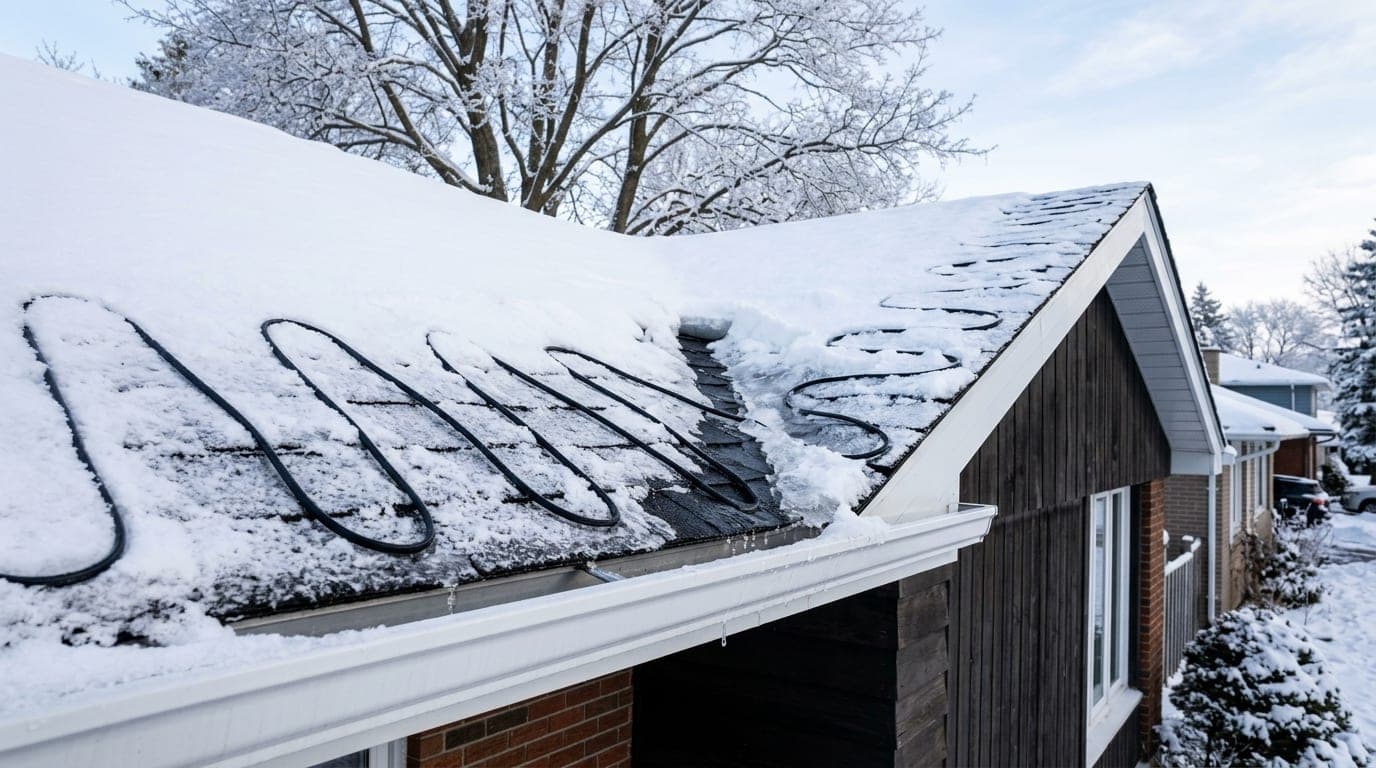
Heat cables are worth it on specific trouble spots, not whole houses. Laid in a zigzag along the roof edge and run down the gutter and downspout, they keep a channel open so meltwater can drain. They don't fix the attic heat loss that causes ice dams, they cost money to run, and they must be installed safely.
What do heat cables actually do?
An ice dam forms when heat escaping through the attic melts snow higher on the roof, and the meltwater refreezes at the cold eave. How ice dams form covers it in detail. A heat cable does not change that heat loss. What it does is keep a narrow path warm: a zigzag melt channel along the roof edge, a warm line along the gutter, and a warm core down the downspout, so water that reaches the edge has somewhere to go instead of freezing in place.
That is a real benefit where ice forms in the same place every winter. It is not a substitute for fixing insulation and ventilation, which is where ice dams start. The ice dam glossary entry has the short version.
What types of heat cable are there?
| Type | How it works | Trade-offs |
|---|---|---|
| Constant-wattage | Puts out the same heat along its length whenever it is on | Cheaper to buy; must be controlled carefully; can overheat if overlapped |
| Self-regulating | Output rises as the cable gets colder and falls as it warms | Costs more; safer, and more efficient in mixed conditions |
| With a controller | A sensor turns the cable on only when it is cold and wet | Adds cost; cuts running hours sharply |
How much do heat cables cost to run?
Work it out from the label and your hydro bill. Multiply the cable's rating in watts per metre by its length, then by the hours it runs, and divide by 1,000 to get kilowatt-hours. Multiply by the rate on your bill.
For example, 30 metres of cable rated around 16 watts per metre (roughly 5 watts per foot) draws about 480 watts. Run 10 hours a day, that is 4.8 kWh a day, or roughly 145 kWh over a month of cold weather. A controller that runs the cable only when it is freezing and wet can cut that dramatically, which is one of the best reasons to have one.
How do you install them safely?
- Use a cable certified for roof and gutter de-icing, with a recognised certification mark such as CSA or cUL.
- Plug into a GFCI-protected outdoor outlet. If you need a new outlet or want the cable hard-wired, hire a Licensed Electrical Contractor, who files the permit (notification of work) with the Electrical Safety Authority.
- Follow the manufacturer's layout exactly, and never overlap or cross constant-wattage cable.
- Use the clips made for your roof and gutters; never nail or staple through shingles.
- Keep the cable in contact with the gutter bottom and running to the bottom of the downspout, so the whole path stays open.
- Test it each fall before the first freeze.
When do heat cables make sense?
- North-facing eaves over an entrance or walkway, where icicles and ice build every winter
- Valleys and inside corners where two roof planes send meltwater into one spot
- Downspouts that freeze solid each year and back water up into the gutter
- Low-slope roof sections that shed snow slowly
- Older homes where fixing attic insulation and ventilation is a longer-term project
When don't they?
- As a whole-house fix for ice dams caused by attic heat loss: fix the attic.
- On gutters that are not kept clean.
- Where a larger downspout or a better discharge would stop the freezing more cheaply. Frozen gutters in winter.
Why are King City estates a common case?
King City's estate homes carry long eavestrough perimeters and complex rooflines with valleys, dormers and shaded north faces, under moraine forest. Those are the rooflines where ice returns to the same corners every winter, and where a targeted heat cable on two or three trouble spots makes more sense than trying to heat the whole perimeter.
Whatever you decide about cables, the late-fall cleaning after the final leaf drop is the step that keeps meltwater moving. Tell us about any heat cables when you book so the crew works around them. Gutter cleaning in King City runs $299 to $499 before HST in 2026 for standard homes, and larger estates are custom-quoted so the crew arrives sized for the job.
Sources
- Electrical Safety Authority: Who can do electrical work at my property?
- Electrical Safety Authority: Notifications and inspections
- Electrical Safety Authority: Recognized certification marks
- Natural Resources Canada: Keeping the Heat In, roofs and attics
Frequently asked questions
Do gutter heat cables prevent ice dams?
Not on their own. They keep a channel open so meltwater can drain past the eave, which reduces damage from ice. The dam itself comes from attic heat melting snow higher up, which insulation and ventilation fix.
How much does it cost to run gutter heat cables?
Multiply the cable's watts per metre by its length and the hours it runs, divide by 1,000 for kilowatt-hours, and multiply by your hydro rate. A controller that runs the cable only in freezing, wet conditions cuts the cost considerably.
Should heat cables be left on all winter?
Not usually. A controller or thermostat that switches the cable on only when it is cold and wet saves energy and wear. Without one, many owners turn cables on during freeze-thaw periods and snowmelt.
Can heat cables go under gutter guards?
Some cable and guard systems are designed to work together. Follow both manufacturers' instructions, because a cable trapped under the wrong guard can overheat or be damaged.
Keep reading
- Skip the fall gutter cleaning? Ice dams, explained
- Frozen gutters and downspouts: what to do this winter
- Gutter guards in the GTA: worth it or not?
- Gutter & eavestrough cleaning: what is included and how it works
- Gutter & eavestrough cleaning in King City: local prices and booking
- Everything we do in King City: neighbourhoods, trees and services